

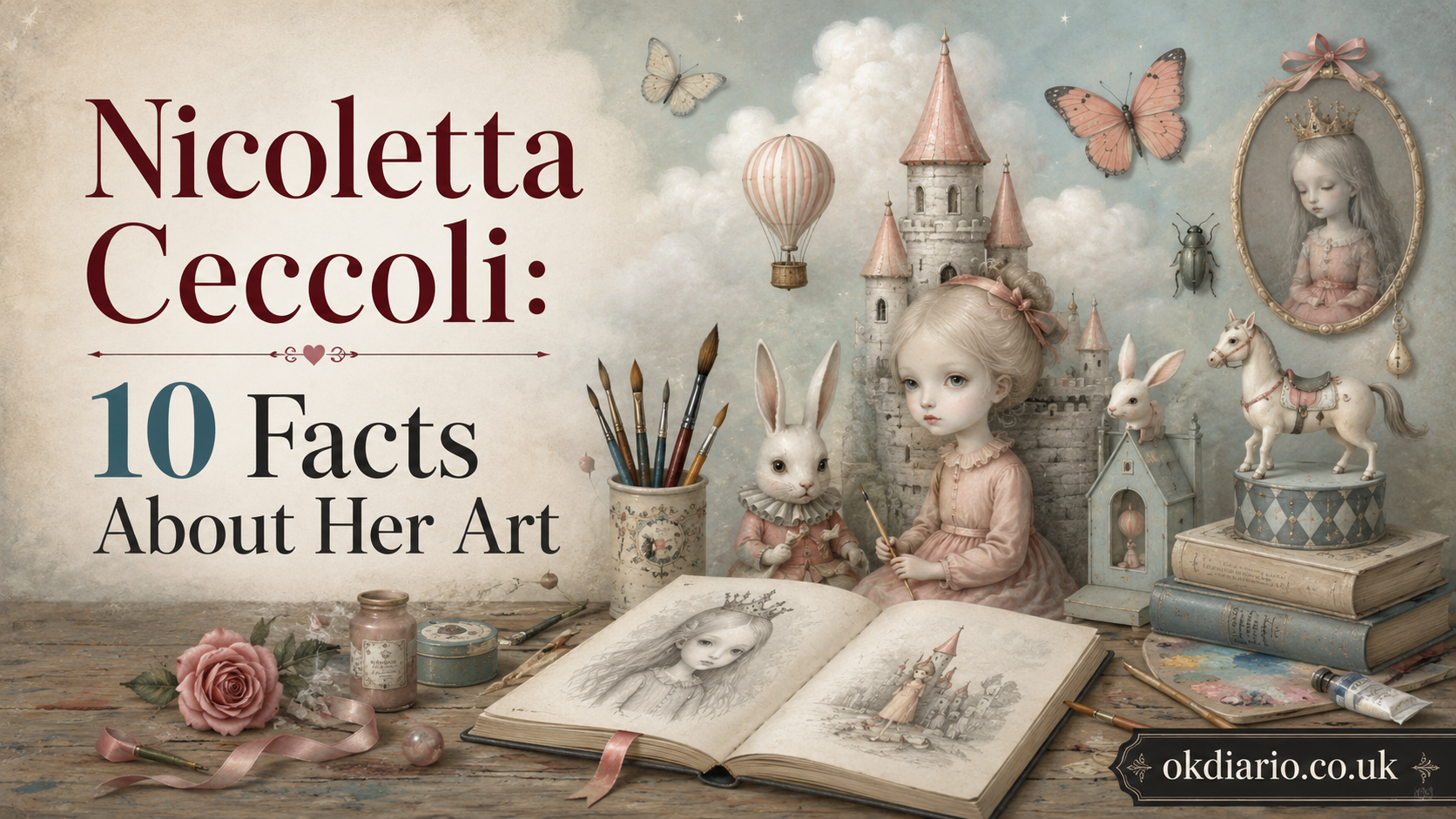
Nicoletta Ceccoli: 10 Facts About Her Art
At first glance, a Nicoletta Ceccoli painting can feel like a page taken from a beautiful children’s book. The colours are soft, the faces are delicate, and the settings seem to belong to a distant dream. Look a little longer, though, and the mood begins to change.
A porcelain-faced girl may be standing beside a strange animal. A sweet toy may seem slightly threatening. A peaceful room may carry a sense of loneliness, danger, or emotional tension. That quiet shift from innocence to unease is one of the reasons her work stays in the mind.
Nicoletta Ceccoli has built a remarkable career by bringing opposite feelings together. Her art can be charming and disturbing, playful and serious, gentle and unsettling at the same time. Rather than explaining every detail, she leaves space for viewers to create their own stories.
Her work has appeared in children’s books, galleries, museums, advertisements, animated projects, posters, and private collections. She has also received respected illustration awards and represented her native San Marino at a major international art event.
So, who is the artist behind these strange yet beautiful worlds? Here are 10 important facts about Nicoletta Ceccoli, her artistic journey, her influences, and the ideas that make her work instantly recognisable.
Nicoletta Ceccoli Biography
| Detail | Information |
|---|---|
| Full Name | Nicoletta Ceccoli |
| Date of Birth | Born in 1973; her exact birth date is not widely confirmed |
| Age | Approximately 52 or 53 in 2026 |
| Profession | Illustrator, painter, visual artist and character designer |
| Nationality | Sammarinese |
| Birthplace | Republic of San Marino |
| Education | Institute of Art in Urbino, Italy |
| Net Worth | Not publicly disclosed or reliably verified |
| Known For | Surreal paintings, children’s book illustrations and dreamlike female characters |
| Notable Works | Beautiful Nightmares, The Girl in the Castle Inside the Museum, The Boo! Book, A Dignity of Dragons and Resta con me |
| Major Achievements | Andersen Prize, Society of Illustrators Silver Medal and multiple Communication Arts Awards of Excellence |
Who Is Nicoletta Ceccoli?
Nicoletta Ceccoli is a Sammarinese artist and award-winning illustrator known for creating detailed fantasy scenes filled with doll-like characters, mysterious animals, antique toys, sweets, masks, forests, castles, and dreamlike landscapes.
She began working professionally as an illustrator during the 1990s. Since then, she has developed a successful career across publishing, commercial illustration, animation, painting, sculpture, and contemporary fine art.
Although she is closely associated with children’s literature, her personal paintings often deal with mature emotional themes. These include loneliness, vulnerability, power, fear, independence, personal growth, love, loss, identity, and the difficult journey from childhood into adulthood.
That wider emotional range has helped Nicoletta Ceccoli attract different audiences. Picture-book readers admire her storytelling, while collectors and gallery visitors are drawn to the psychological depth beneath her pastel colours.
1. Nicoletta Ceccoli Was Born and Raised in San Marino
Nicoletta Ceccoli was born in 1973 in the Republic of San Marino, a small independent country surrounded by Italy. She continues to live and work there.
San Marino may be small, but its medieval architecture, hilltop towers, narrow streets, old buildings, and surrounding countryside offer the kind of visual atmosphere that seems perfectly suited to her imagination.
Ceccoli grew up within sight of a landscape that already felt connected to fairy tales. Ancient stone structures, misty hills, quiet rural spaces, and historic architecture can encourage a child to imagine hidden kingdoms and forgotten stories. It is easy to see traces of that environment in her later paintings.
Her backgrounds often feel timeless. They do not belong completely to the modern world, nor do they fit neatly within a specific historical period. Instead, they seem suspended between memory and fantasy.
That quality is important. Nicoletta Ceccoli does not simply paint imaginary characters. She builds complete visual worlds around them. The setting, furniture, clothing, animals, toys, and empty spaces all contribute to the story.
The Influence of a Quiet Childhood
Her rural upbringing also gave her close contact with animals. Hens, rabbits, birds, and other creatures were part of her surroundings. In her mature work, animals frequently appear as companions, symbols, threats, or emotional reflections of the main character.
Sometimes they appear friendly. At other times, their role is harder to understand. This uncertainty makes the scene more compelling.
2. Her Family Encouraged Her Creativity
Creative interests often begin with small childhood experiences, and that was true for Nicoletta Ceccoli.
Her father was a craftsman, and she spent time in his workshop making toys and objects by hand. This early contact with physical materials may help explain why so many objects in her paintings feel solid and carefully constructed.
Even when she paints something impossible, it often appears to have real weight, texture, and volume. A toy looks as though it could be picked up. A cake appears soft enough to cut. A porcelain figure seems smooth, cold, and fragile.
Her mother, meanwhile, worked as a primary school teacher. Through her, Ceccoli developed a lasting love of illustrated books and visual storytelling.
Children’s books were not simply entertainment. They became places where words, pictures, emotions, and imagination could work together. That relationship stayed with her as she grew older.
Rather than leaving childhood imagery behind, she continued to study it. She explored why nursery tales can feel comforting one moment and frightening the next. She also noticed that classic fairy tales often contain danger, transformation, jealousy, cruelty, and loss beneath their colourful surfaces.
This understanding became central to her artistic identity.
3. She Studied Animation at the Institute of Art in Urbino
Nicoletta Ceccoli attended the Institute of Art in Urbino, Italy, where she focused on animation during the final stage of her studies.
Urbino is known for its Renaissance history and remarkable architecture. Studying art in such an environment offered more than technical training. It surrounded her with classical paintings, historic buildings, carefully balanced compositions, and centuries of visual culture.
One important influence was the Renaissance painter Piero della Francesca. His work is admired for its stillness, clarity, controlled space, and quiet figures. Similar qualities can be seen in Ceccoli’s compositions.
Her characters often remain unusually calm, even when something strange is happening. They may be surrounded by monsters, oversized insects, broken toys, or impossible landscapes, yet their expressions are controlled and distant.
That stillness makes the images more powerful. A dramatic facial expression might tell the viewer what to feel. A calm face, however, leaves the emotional meaning open.
How Animation Shaped Her Storytelling
Animation training also helped Nicoletta Ceccoli think beyond a single image. Her paintings often feel like paused moments from a longer story.
The viewer naturally wonders:
- What happened before this scene?
- Is the character in danger?
- Is the creature a friend or an enemy?
- Is the setting real, imagined, or remembered?
- What will happen after the image ends?
This sense of movement and unfinished narrative gives her artwork a cinematic quality.
4. Her Professional Career Began in 1995
A major turning point came in 1995, when Nicoletta Ceccoli’s work was selected for the Bologna Children’s Book Fair illustration exhibition.
The Bologna Children’s Book Fair is an important international gathering for publishers, authors, illustrators, agents, and creative professionals. Being selected gave the young artist valuable exposure and helped open the door to professional opportunities.
Afterward, she began receiving commissions from publishers, including companies based outside Italy. This allowed her to develop an international career while continuing to live in San Marino.
Since 1995, Nicoletta Ceccoli has created illustrations for children’s books, magazines, book covers, posters, advertisements, music projects, and other editorial work.
Her client history includes major names from publishing, fashion, travel, and retail. However, the most important achievement is not simply the number of clients she has attracted. It is her ability to keep a clear artistic identity while working across different commercial formats.
Many illustrators must adjust their style to suit a project. Ceccoli has done that too, especially in her earlier book work. Yet her visual personality remains easy to recognise.
5. She Has Illustrated More Than 30 Children’s Books
Children’s literature played a central role in the rise of Nicoletta Ceccoli. Over the years, she has illustrated more than 30 books for publishers in different countries.
Her illustrations work especially well with stories involving fantasy, mystery, unusual creatures, emotional journeys, enchanted places, and fairy-tale themes.
Among her recognised book projects are:
- The Girl in the Castle Inside the Museum
- The Boo! Book
- Oscar and the Mooncats
- Little Red Riding Hood
- A Dignity of Dragons
- Le avventure di Pinocchio
- La foresta radice labirinto
- Nuvole
- Resta con me
The Girl in the Castle Inside the Museum
The Girl in the Castle Inside the Museum is a strong example of the themes that suit Ceccoli’s art. The story centres on a tiny girl who lives inside a castle displayed in a museum.
The idea is magical, but it also carries sadness. The girl is surrounded by visitors, yet she remains alone. That mixture of wonder and loneliness fits naturally with Nicoletta Ceccoli’s visual language.
Why Her Book Illustrations Feel Different
Her picture-book art does more than describe the text. It adds atmosphere, mood, hidden details, and emotional meaning.
A child may enjoy the fantasy, animals, costumes, and colours. An adult may notice isolation, uncertainty, symbolism, or a deeper psychological struggle. As a result, the illustrations can appeal to readers at different ages.
6. Her Signature Style Blends Sweetness With Darkness
The most recognisable feature of Nicoletta Ceccoli’s art is contrast.
Her characters often have pale skin, rounded faces, large heads, delicate features, and calm expressions. They may wear vintage dresses, ribbons, crowns, costumes, or theatrical clothing. Around them are cakes, sweets, dolls, rabbits, birds, insects, flowers, toy houses, and soft pastel clouds.
Yet something is often wrong.
A piece of candy may appear dangerous. A toy may be wounded. A friendly creature may have sharp teeth. A beautiful room may feel like a trap. A fairy-tale heroine may seem powerful, frightened, or both.
This balance between attraction and discomfort creates emotional tension. The viewer is pulled closer by the beauty but held in place by the mystery.
Nicoletta Ceccoli’s art is often connected with contemporary surrealism, pop surrealism, lowbrow art, fantasy illustration, and new contemporary art. Still, her style does not fit perfectly into one label.
She combines elements of:
- Classical composition
- Fairy-tale illustration
- Surreal imagery
- Gothic fantasy
- Vintage toys
- Symbolic storytelling
- Psychological portraiture
- Pop culture
- Children’s literature
- Dream logic
The result feels familiar without becoming predictable.
7. Her Female Characters Are More Powerful Than They Appear
Many personal works by Nicoletta Ceccoli feature young-looking, doll-like female protagonists. Their porcelain faces may suggest innocence or fragility, but their roles are often much more complex.
These characters are not always helpless figures waiting to be rescued. Some control animals, confront monsters, challenge traditional fairy-tale roles, or survive strange emotional landscapes.
A girl may appear small beside an enormous creature, yet she may still hold the power within the scene. Another may seem trapped but also emotionally distant from whatever is trying to control her.
This tension raises questions about strength and vulnerability.
The Meaning Behind the Doll-Like Figures
The doll can represent beauty, perfection, childhood, control, or fragility. However, a doll is also an object that can be dressed, moved, displayed, owned, or broken.
By giving doll-like characters emotional depth, Nicoletta Ceccoli turns that familiar object into something more human. Her figures seem caught between being people and being possessions.
This can lead viewers to think about social expectations, appearance, identity, freedom, and the pressure to remain pleasing or perfect.
Her female protagonists may be quiet, but they are rarely empty. Their silence feels intentional.
8. She Uses Traditional Painting Materials
Although Nicoletta Ceccoli’s scenes can look digitally perfect, much of her best-known fine art has been produced with traditional materials.
Acrylic paint on paper has played an important part in her practice. Earlier book projects also involved acrylics and pastels, while other commissions have used mixed-media methods.
Her smooth transitions and carefully blended surfaces give the figures a soft, luminous finish. The colours are often gentle rather than harsh, with pale pink, powder blue, cream, grey, peach, muted green, and deep shadow appearing throughout her work.
However, creating a soft appearance does not mean the process is simple. Her paintings require control, patience, strong drawing skills, colour knowledge, and careful planning.
Important Visual Features in Her Technique
Several features appear repeatedly:
- Smooth shading
- Delicate highlights
- Rounded forms
- Controlled compositions
- Fine surface detail
- Soft colour palettes
- Realistic texture
- Unusual scale
- Empty or quiet backgrounds
- Strong central characters
Scale is especially important. A girl may be tiny beside a cake, flower, insect, wolf, or toy. By changing normal proportions, Ceccoli makes an ordinary object feel magical or threatening.
9. Nicoletta Ceccoli Has Won Major Illustration Awards
Talent alone does not always lead to professional recognition. In Nicoletta Ceccoli’s case, however, her illustration work has earned several respected honours.
In 2001, she received the Andersen Prize “Baia delle Favole” as Italy’s best illustrator of the year. This award strengthened her position within children’s publishing and recognised the quality of her visual storytelling.
In 2006, she received a Silver Medal from the Society of Illustrators in New York. The organisation is well known within the international illustration community, making the honour an important career achievement.
Her official career record also lists several Communication Arts Awards of Excellence. These honours reflect her ability to combine imagination with professional craft.
Awards do not explain why an artwork matters, of course. Art remains personal, and viewers may respond differently to the same image. Nevertheless, these achievements show that Ceccoli’s work has been respected by publishers, art directors, fellow illustrators, judges, galleries, and collectors.
10. Her Career Expanded From Books Into Global Fine Art
Nicoletta Ceccoli first became widely known through illustration, but her career gradually expanded into gallery and museum exhibitions.
Her solo shows have appeared in cities such as Toronto, Seattle, Manchester, Rome, New York, Los Angeles, and St Petersburg. Exhibition titles including Babes in Toyland, Eye Candy, Sweet and Low, Hide and Seek, Scary Faery Tales, and Handle With Care reveal the recurring concerns in her work.
Even the titles mix playfulness with tension.
Handle With Care
Her 2022 exhibition Handle With Care explored innocence, emotional pain, love, loss, maturity, personal fear, and human vulnerability.
The title itself feels perfectly suited to her figures. They look fragile, like porcelain ornaments, yet they often survive strange and difficult experiences.
The show presented paintings in acrylic on paper and continued her exploration of the space between the cute and the grotesque. Rather than dividing characters into simple heroes and villains, the work questioned the difference between good and evil, strength and weakness, safety and danger.
The Venice Biennale
In 2022, Nicoletta Ceccoli represented San Marino as part of the country’s participation in the 59th Venice Biennale.
The Venice Biennale is one of the world’s most recognised international art events. Appearing within that context marked an important stage in her journey from book illustrator to globally exhibited contemporary artist.
Her participation also demonstrated that illustration and fine art do not need to remain separate worlds. An artist can work with books, commercial clients, exhibitions, animation, and collectible art without losing creative depth.
Nicoletta Ceccoli’s Work in Animation and Design
Ceccoli’s animation education has remained relevant throughout her career.
In 2008, she contributed design work to the French animated project La Mécanique du cœur. The story’s mechanical fantasy, romantic darkness, and unusual characters made it a natural match for her imagination.
She later designed animation elements for Phoenix Rising, an HBO documentary directed by Amy Berg.
These projects show the flexibility of her visual language. Her characters can live on a book page, inside a painting, or within a moving sequence.
She has also worked on advertising, magazine illustrations, album-related artwork, posters, packaging, and visual identity projects. Yet even when the format changes, her interest in narrative remains clear.
Why Is Nicoletta Ceccoli’s Art So Popular?
There is no single reason for her international appeal. Instead, several qualities work together.
First, the art is visually inviting. Her colour palettes are beautiful, her characters are memorable, and her paintings contain details that reward close attention.
Second, the emotional meaning is open. Nicoletta Ceccoli rarely gives the viewer a simple answer. The scene may suggest fear, freedom, sadness, rebellion, or transformation, depending on who is looking.
Third, her work connects childhood memories with adult emotions. Most people remember toys, fairy tales, sweets, costumes, picture books, and imaginary creatures. Ceccoli uses those familiar objects, then changes their meaning.
Finally, her art tells stories without requiring words. A viewer from almost any culture can enter the image and begin imagining what is happening.
Common Symbols in Nicoletta Ceccoli’s Artwork
Ceccoli’s paintings contain many repeating images. Their meanings can change from one work to another, but several broad interpretations are possible.
| Symbol | Possible Meaning |
|---|---|
| Dolls | Fragility, beauty, control or identity |
| Animals | Instinct, companionship, fear or hidden power |
| Sweets and cakes | Desire, pleasure, temptation or excess |
| Masks | Hidden emotion, performance or self-protection |
| Insects | Transformation, discomfort or vulnerability |
| Castles | Imagination, isolation, safety or confinement |
| Wolves | Threat, wildness, desire or misunderstood strength |
| Broken toys | Lost innocence, emotional damage or change |
| Oversized objects | Fear, wonder or a child’s sense of scale |
| Porcelain skin | Perfection, delicacy, artificial beauty or emotional distance |
These interpretations are not fixed rules. That is part of the pleasure of looking at her work. Each viewer can develop a different reading.
What Makes Nicoletta Ceccoli Different From Other Fantasy Artists?
Many fantasy artists create beautiful imaginary worlds. Nicoletta Ceccoli stands apart because her beauty is never completely safe.
Her work does not depend on dramatic battles, heroic poses, or complex fantasy mythology. Instead, she creates quiet psychological scenes. The conflict may exist inside the character rather than around her.
She also avoids making every image easy to understand. A painting may feel like a memory whose beginning and ending have been forgotten. This gives the work a personal, dreamlike quality.
Most importantly, her art respects the complexity of childhood. It does not treat childhood as purely happy, simple, or innocent. It recognises that children can experience fear, jealousy, loneliness, curiosity, courage, confusion, and strong imagination.
That emotional honesty gives the work lasting depth.
Final Thoughts on Nicoletta Ceccoli and Her Art
Nicoletta Ceccoli has created a visual world that is difficult to confuse with anyone else’s. Her porcelain-faced characters, strange animals, delicate colours, old-fashioned toys, surreal settings, and emotional contradictions have become part of a distinctive artistic language.
Her journey began with books and drawing, developed through formal animation training, and gained momentum at the Bologna Children’s Book Fair. From there, she built an international illustration career, contributed to animated projects, won major awards, exhibited around the world, and represented San Marino at the Venice Biennale.
However, career milestones tell only part of the story.
The real strength of Nicoletta Ceccoli lies in her ability to make viewers feel two things at once. Her paintings are lovely, yet uneasy. They feel young, yet emotionally mature. They appear quiet, yet suggest that a much larger story is unfolding just outside the frame.
That balance is why people continue to return to her work. Every image offers something beautiful to admire and something mysterious to question.
Which Nicoletta Ceccoli painting, illustration, or book has stayed with you the longest? Share your thoughts and pass this article along to another art lover who enjoys surreal, imaginative storytelling.