

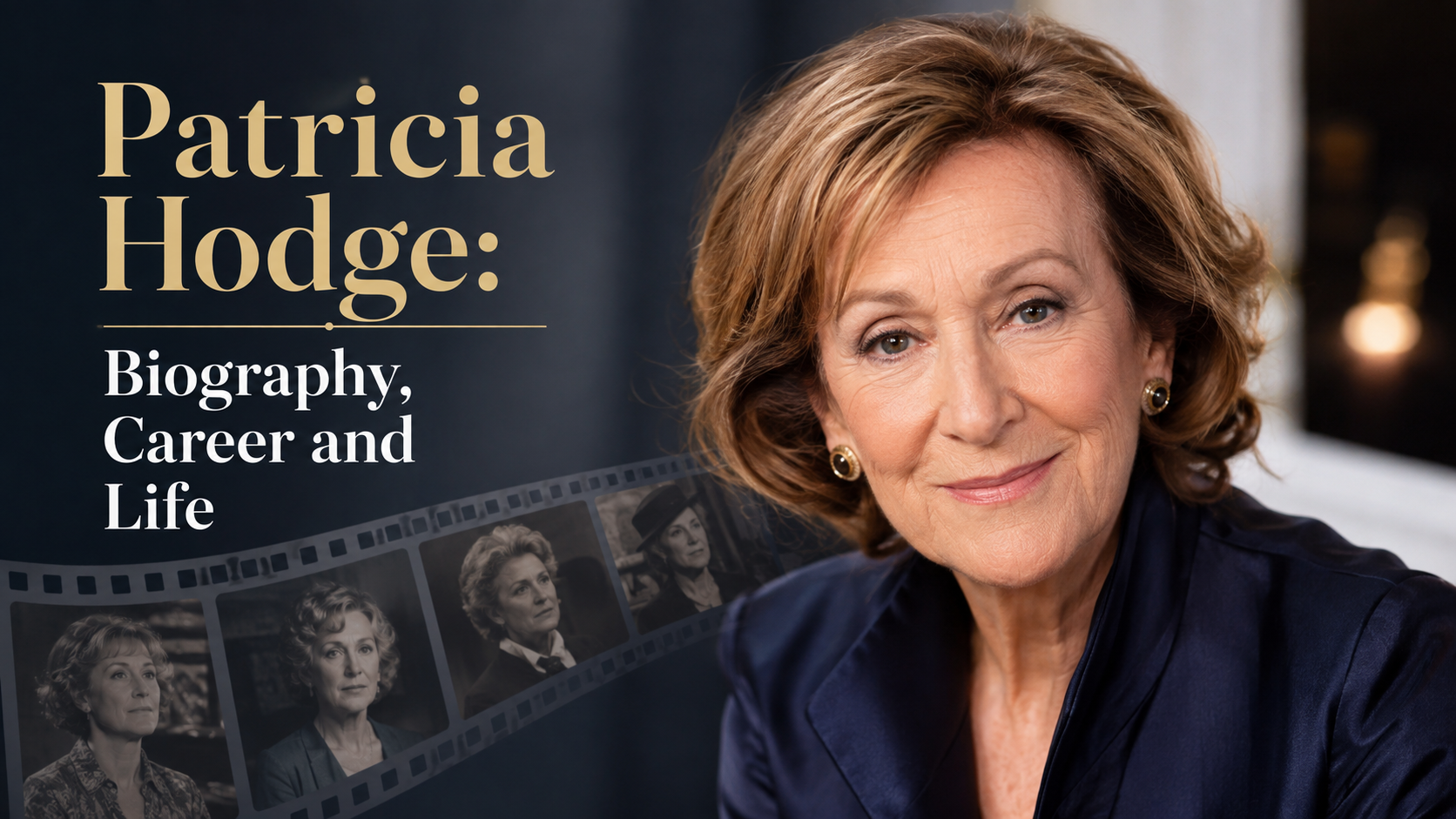
Patricia Hodge: Biography, Career and Life
Patricia Hodge is one of Britain’s most respected actresses, with a career spanning more than five decades across theatre, television and film. Known for her intelligence, comic timing and commanding stage presence, she has built a reputation for playing everything from sophisticated dramatic characters to memorable comedy roles.
For many viewers, Patricia Hodge is especially recognizable as Penny, Miranda’s self-absorbed but hilarious mother in the BBC sitcom Miranda. Others know her as Phyllida Erskine-Brown in Rumpole of the Bailey, Jemima Shore in Jemima Shore Investigates, or Mrs Pumphrey in All Creatures Great and Small. Her screen work, however, represents only part of her career.
Theatre has always been central to Patricia Hodge’s professional life. She trained at the London Academy of Music and Dramatic Art (LAMDA), established herself on the British stage, appeared in major West End productions and won the Olivier Award for Best Supporting Actress for Money in 2000. She was also appointed an OBE in 2017 for services to drama.
This biography explores Patricia Hodge’s early life, education, rise to prominence, major acting roles, theatre achievements, family life and lasting contribution to British entertainment.
Key Takeaways
- Patricia Hodge was born on September 29, 1946, in Cleethorpes, Lincolnshire, and grew up in the Grimsby area.
- She trained at LAMDA after initially preparing for a career in teaching.
- Her career encompasses theatre, television and film, with particularly strong links to British stage and television drama.
- Major television roles include Rumpole of the Bailey, Jemima Shore Investigates, Miranda and All Creatures Great and Small.
- She won the 2000 Olivier Award for Best Supporting Actress for Money.
- Patricia Hodge was appointed an OBE in 2017 for services to drama.
Patricia Hodge Biography Table
| Detail | Information |
|---|---|
| Full Name | Patricia Ann Hodge |
| Date of Birth | September 29, 1946 |
| Age | 79 as of August 2026 |
| Birthplace | Cleethorpes, Lincolnshire, England |
| Nationality | British |
| Profession | Actress |
| Education | LAMDA; earlier studied at Maria Grey College |
| Years Active | 1971–present |
| Known For | Rumpole of the Bailey, Miranda, Jemima Shore Investigates, All Creatures Great and Small |
| Major Achievements | Olivier Award winner; OBE for services to drama |
| Estimated Net Worth | Not included because reliable public figures are unavailable |
Early Life and Family Background
Patricia Hodge was born Patricia Ann Hodge on September 29, 1946, in Cleethorpes, Lincolnshire. She grew up in and around Grimsby, where her parents, Eric and Marion Hodge, were involved in the hotel business.
Her upbringing was not initially focused on show business. She attended Wintringham Girls’ Grammar School in Grimsby and later St Helen’s School in Northwood, Middlesex. She then studied at Maria Grey College in Twickenham, where she trained to become a teacher.
That early experience is an interesting part of Patricia Hodge’s story because teaching could have become her permanent profession. Instead, acting gradually became the career she wanted to pursue.
She worked as a teacher while applying to the London Academy of Music and Dramatic Art. Her eventual acceptance into LAMDA marked a major turning point.
Patricia Hodge and LAMDA
Training at LAMDA gave Patricia Hodge the professional foundation for a career on stage and screen. She entered the academy at the age of 22 and graduated with the Eveline Evans Award for Best Actress, an early indication of her potential as a performer.
Her theatrical training would prove particularly valuable throughout her career.
Unlike performers who became famous primarily through television, Hodge developed a strong stage background before becoming widely recognized by television audiences. That foundation helped her move comfortably between comedy, serious drama, classical theatre and contemporary productions.
Her career demonstrates how extensive theatrical experience can translate into screen work without limiting an actor to one particular type of role.
The Beginning of Her Acting Career
Patricia Hodge’s professional stage career began in the early 1970s. She made an early stage appearance at Edinburgh’s Traverse Theatre, and her career soon expanded into London’s theatre scene.
Her West End work became an important part of her development. She appeared in Pippin, a production associated with celebrated American director and choreographer Bob Fosse, during the early 1970s.
Rather than immediately becoming identified with a single screen persona, Hodge built her reputation through a broad range of theatrical performances.
That versatility became one of the defining characteristics of her career.
Patricia Hodge’s Theatre Career
Theatre has remained at the heart of Patricia Hodge’s professional identity.
Over the years, she has appeared in productions ranging from modern drama and comedy to musicals and classic plays. Her stage credits include productions such as The Mitford Girls, Noël and Gertie, A Little Night Music, Private Lives, Watch on the Rhine and A Day in the Death of Joe Egg.
Her work in theatre has also earned major recognition.
Olivier Award Success
Patricia Hodge received Olivier Award recognition for several performances during her career. Her nominations included work in musicals such as The Mitford Girls and Noël and Gertie.
Her most significant Olivier success came in 2000, when she won Best Supporting Actress for her performance in Money at the National Theatre.
The award was particularly significant because it recognized the quality of her stage acting at a point when she was already an established performer.
Her theatre career illustrates an important aspect of Patricia Hodge’s reputation: she has never been defined solely by television popularity.
Patricia Hodge on Television
Television introduced Patricia Hodge to a much wider audience and gave her opportunities to portray characters across a broad range of genres.
Her television credits include comedy, period drama, adaptations and long-running British series. Among her best-known roles are Phyllida Erskine-Brown in Rumpole of the Bailey and Jemima Shore in Jemima Shore Investigates.
She also appeared in productions including Edward and Mrs Simpson, The Life and Loves of a She-Devil and The Cloning of Joanna May. Her television career has therefore covered several decades and numerous styles of storytelling.
Rumpole of the Bailey
One of Patricia Hodge’s important early television roles was Phyllida Erskine-Brown in Rumpole of the Bailey.
The character gave Hodge an opportunity to work within a sophisticated legal drama while demonstrating the controlled, articulate performance style that became associated with many of her roles.
The series also helped establish her as a familiar face among audiences who appreciated British television drama.
Jemima Shore Investigates
Patricia Hodge also played the title character in Jemima Shore Investigates, based on the novels by Antonia Fraser.
Jemima Shore was an independent television journalist who became involved in investigations and mysteries. The role allowed Hodge to take on a more central part in a television series and reinforced her ability to carry a production.
Miranda
For a later generation of viewers, Patricia Hodge became particularly recognizable as Penny, the mother of Miranda Hart’s title character in the BBC sitcom Miranda.
Penny is dramatic, socially conscious and frequently preoccupied with appearances and marriage. Her comic confidence and exaggerated reactions became an important part of the show’s humor.
Hodge’s performance worked because she played Penny seriously rather than treating every line as a joke. The character’s confidence and absurdity became funnier because Hodge committed fully to the role.
The series ran from 2009 to 2015 and introduced Patricia Hodge to many viewers who may have known her primarily from drama or theatre.
All Creatures Great and Small
Another major chapter in Patricia Hodge’s later television career has been All Creatures Great and Small.
She plays Mrs Pumphrey in the popular adaptation of James Herriot’s stories. The role showcases another side of her acting: polished, eccentric and affectionate comedy within a period-drama setting.
Her involvement in the series has helped introduce her work to a contemporary international television audience. Patricia Hodge has remained active on screen well into her seventies, reinforcing the longevity of her career.
Patricia Hodge’s Film Career
Although television and theatre have generally been more prominent in Patricia Hodge’s career, she has also appeared in feature films and television movies.
One of her notable film appearances came in Betrayal, the 1983 adaptation of Harold Pinter’s play. She appeared alongside a distinguished cast, including Jeremy Irons and Ben Kingsley.
Her screen credits also include The Elephant Man and other film and television productions.
Hodge’s film work demonstrates the same versatility found in her theatre and television career. She has moved between character roles without becoming confined to a single genre.
Patricia Hodge’s Awards and Honours
Patricia Hodge’s career has received recognition from major British cultural institutions.
Olivier Award
Her most prominent competitive theatre award is the Olivier Award she won for Best Supporting Actress for Money in 2000. She had also received Olivier recognition for earlier stage performances.
BAFTA Recognition
Hodge has also received BAFTA recognition, including a nomination for her performance in Hotel du Lac.
BAFTA recognition is significant in British screen acting because it reflects peer and industry appreciation within the country’s film and television community.
OBE
In 2017, Patricia Hodge was appointed an Officer of the Order of the British Empire, or OBE, for services to drama.
The honor reflects the broader significance of her career rather than one individual performance. After decades of work in British theatre, television and film, the recognition acknowledged her contribution to drama.
Patricia Hodge’s Acting Style
One reason Patricia Hodge has remained relevant across generations is her ability to combine precision with personality.
Her performances often have several qualities in common:
- Strong diction and vocal control
- Confident stage presence
- Excellent comic timing
- Ability to handle sophisticated dialogue
- Comfort with both dramatic and comedic material
- A natural ability to portray authoritative characters
- Strong attention to character detail
Her theatre background is especially visible in performances where dialogue carries much of the scene.
At the same time, her comedy roles show that theatrical technique does not have to make a performer feel distant or overly formal. As Penny in Miranda, for example, Hodge turned a highly theatrical personality into one of the show’s most memorable comic characters.
Patricia Hodge’s Personal Life and Family
Patricia Hodge married music publisher Peter Owen in 1976. They remained married for more than four decades until his death in 2016. They had two sons, Alexander and Edward.
Hodge has spoken publicly about the impact of caring for her husband when he developed dementia and about rebuilding her life following his death. In a later interview, she described work as an important source of purpose and engagement during that period.
These experiences provide an important perspective on her life away from the screen. Her career has not simply been a sequence of acting credits; work has remained a significant part of her identity through major personal changes.
Why Patricia Hodge Remains Important to British Acting
Patricia Hodge’s career is notable because it crosses several generations of British entertainment.
She established herself during an era when theatre provided an important route for serious actors, developed a substantial television career during the golden age of British drama and later became widely recognized by younger audiences through comedy and contemporary television.
Her career can be understood through three connected areas:
| Area | Contribution |
|---|---|
| Theatre | Established her reputation as a versatile stage performer |
| Television | Built a broad audience through drama, comedy and adaptations |
| Film | Added notable character performances to an already extensive career |
Few actors maintain relevance across such different forms of entertainment for so long.
Patricia Hodge’s Most Recognizable Roles
For readers discovering Patricia Hodge’s work for the first time, several productions provide a useful starting point.
1. Miranda
Start here for comedy. Penny showcases Hodge’s sharp comic timing and ability to create a memorable character from distinctive mannerisms and dialogue.
2. Rumpole of the Bailey
This is an excellent choice for viewers interested in her earlier television work and British legal drama.
3. Jemima Shore Investigates
The series demonstrates Hodge’s ability to lead a television production rather than simply support an ensemble cast.
4. All Creatures Great and Small
This later role highlights her continued ability to make eccentric, sophisticated characters feel warm and entertaining.
5. Betrayal
For viewers interested in her film work, Betrayal offers an opportunity to see Hodge in a more serious dramatic setting.
What Makes Patricia Hodge’s Career Stand Out?
The most remarkable feature of Patricia Hodge’s career is not one specific role. It is the consistency and range of her work.
She has performed in serious drama, comedy, musicals, classical theatre, television adaptations and film. She has also remained active over a period when many performers naturally reduce their workload.
Her success offers a useful lesson about longevity in acting. Rather than relying on a single defining character, Hodge developed a body of work broad enough to keep opening new opportunities.
That versatility is particularly clear when comparing Penny in Miranda with Mrs Pumphrey in All Creatures Great and Small or her dramatic theatre performances. The characters may have little in common, but Hodge’s performances remain recognizable for their precision and confidence.
Frequently Asked Questions
Who is Patricia Hodge?
Patricia Hodge is an English actress known for an extensive career in theatre, television and film. Her best-known roles include Penny in Miranda, Phyllida Erskine-Brown in Rumpole of the Bailey, Jemima Shore and Mrs Pumphrey in All Creatures Great and Small.
How old is Patricia Hodge?
Patricia Hodge was born on September 29, 1946. As of August 2026, she is 79 years old.
Where was Patricia Hodge born?
She was born in Cleethorpes, Lincolnshire, England, and grew up in the Grimsby area.
What is Patricia Hodge best known for?
She is particularly well known for Rumpole of the Bailey, Jemima Shore Investigates, Miranda and All Creatures Great and Small. Her theatre career is also a major part of her professional legacy.
Did Patricia Hodge win an Olivier Award?
Yes. Patricia Hodge won the Olivier Award for Best Supporting Actress in 2000 for her performance in Money.
Did Patricia Hodge receive an OBE?
Yes. She was appointed an OBE in 2017 for services to drama.
Who did Patricia Hodge play in Miranda?
Patricia Hodge played Penny, Miranda’s mother, in the BBC sitcom Miranda. The series ran from 2009 to 2015.
Who does Patricia Hodge play in All Creatures Great and Small?
Patricia Hodge plays Mrs Pumphrey in All Creatures Great and Small. The role forms part of her later television career and introduces her work to a new generation of viewers.
Conclusion
Patricia Hodge has built the kind of acting career that is difficult to reduce to a single genre, decade or signature role. From her early theatrical training at LAMDA to major West End productions, acclaimed television dramas, comedy and later work in All Creatures Great and Small, she has consistently demonstrated remarkable versatility.
Her Olivier Award, BAFTA recognition and OBE reflect different aspects of that contribution. Yet awards alone do not explain her lasting appeal. Patricia Hodge has remained successful because she understands character, dialogue and performance at a deeply professional level.
For audiences who know her as Penny in Miranda, discovering her earlier theatre and television work reveals a much broader career. For longtime followers of British drama, her later performances demonstrate that her ability to command a scene has remained remarkably strong.
Patricia Hodge’s legacy ultimately rests on range, longevity and craftsmanship. Her work across stage, television and film has made her a distinctive figure in British acting, while her continued presence on screen shows why generations of viewers continue to value her performances.