

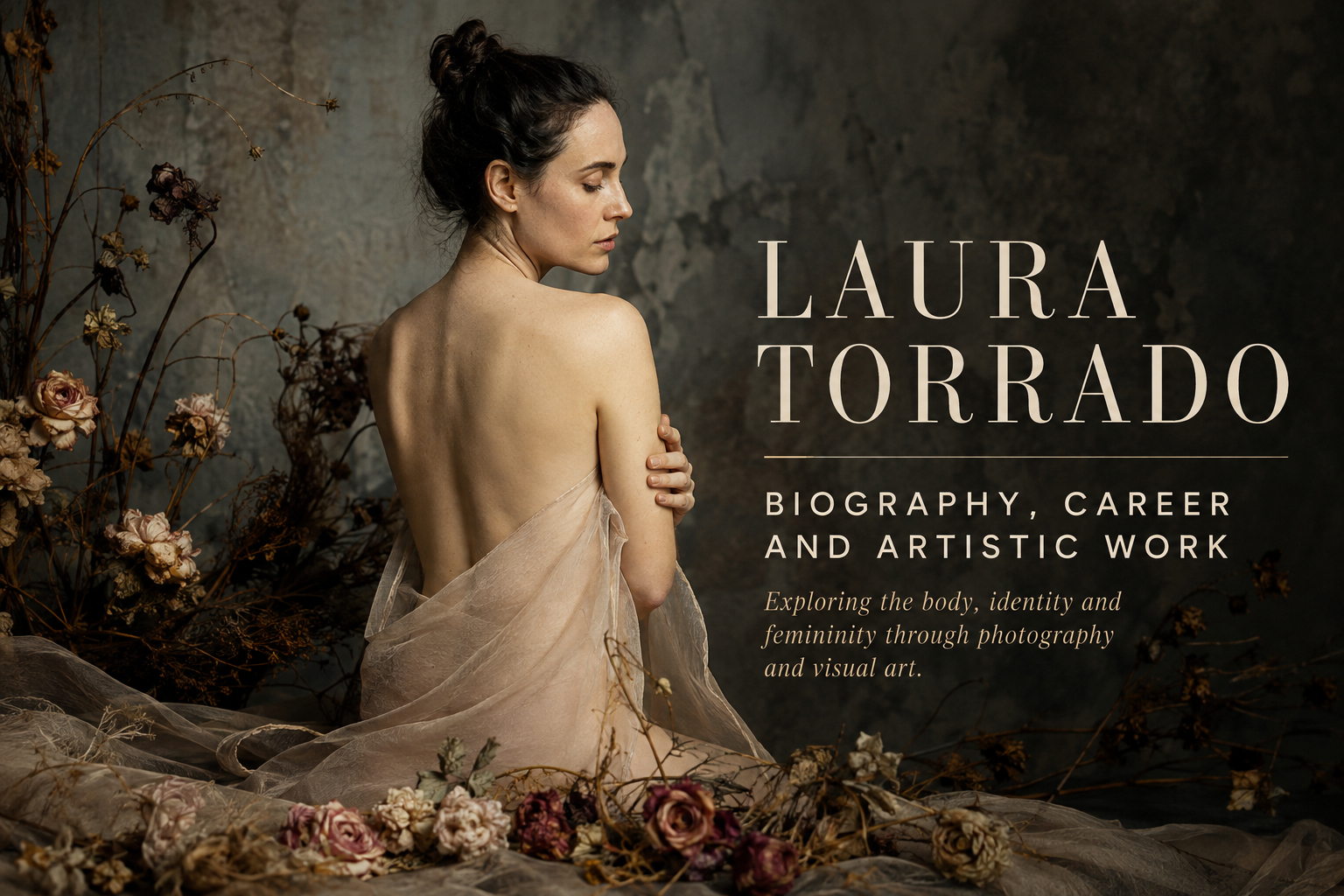
Laura Torrado: Biography, Career and Artistic Work
Laura Torrado is a Spanish visual artist whose work has consistently explored the body, identity, femininity, memory, beauty and the uneasy relationship between attraction and mortality. Although photography is central to her practice, describing her simply as a photographer would overlook the broader language of her work. She also works across video, drawing, installation, sculpture and staged visual environments.
Born in Madrid in 1967, Torrado developed her artistic practice through formal training in Spain and further study in the United States. Her international experience included work with the conservation departments of the Solomon R. Guggenheim Museum and the Museum of Modern Art in New York, as well as postgraduate study at institutions including the School of Visual Arts and New York University.
Over several decades, Laura Torrado has built a distinctive body of work in which photography frequently functions as a constructed stage. Her images can resemble fragments of theatre, performance or painting, while her installations and sculptural elements demonstrate that her artistic concerns extend beyond the camera.
Her career includes major exhibitions, awards, international presentations and inclusion in important public and private collections. More recently, projects such as Ouroboros have continued her interest in transformation, symbolism, the Baroque and the passage between life, death and renewal.
Key Takeaways
- Laura Torrado is a Spanish multidisciplinary visual artist born in Madrid in 1967.
- Her practice combines photography with video, drawing, installation, sculpture and performance-related approaches.
- The body, femininity, identity, desire, vulnerability and mortality are recurring themes in her work.
- Her international career was shaped in part by her studies and professional experience in New York.
- Major projects include Transhumance, Hammam, El Dormitorio, The Insides and Vida Suspendida.
- Her work has appeared in exhibitions and collections associated with institutions such as the Museo Nacional Centro de Arte Reina Sofía, Museo Patio Herreriano and CGAC.
Biography Table
| Biography Detail | Information |
|---|---|
| Full Name | Laura Torrado |
| Date of Birth | 1967 |
| Birthplace | Madrid, Spain |
| Nationality | Spanish |
| Profession | Visual artist, photographer and educator |
| Education | Fine Arts at the Universidad Complutense de Madrid; postgraduate studies in New York; doctorate in Fine Arts |
| Years Active | 1990s–present |
| Known For | Photography, visual art, staged imagery, representations of the body and explorations of femininity |
| Major Achievements | Altadis Plastic Arts Prize, Purificación García Photography Prize, Generación awards, Community of Madrid Plastic Arts Prize and other distinctions |
| Estimated Net Worth | Not reliably publicly documented |
Who Is Laura Torrado?
Laura Torrado is a Spanish contemporary artist known for an introspective and multidisciplinary practice. Her work frequently places the human body at the center of carefully constructed visual situations.
Rather than treating photography as a straightforward record of reality, Torrado often uses the medium to create fictional or symbolic worlds. Her photographs can therefore feel closer to theatre or painting than conventional documentary photography.
Her own artistic statement describes an interest in the body as a territory of conflict and in eroticism as an impulse connected with life. This helps explain why her images often combine beauty with tension, vulnerability, desire or unease.
The female body has been particularly important throughout her career. Her work questions cultural assumptions about femininity instead of presenting female identity as a fixed or uncomplicated category.
This approach has made Laura Torrado an important figure for understanding strands of contemporary Spanish photography that use staged imagery, symbolism and the body to examine identity and social expectations.
Early Life and Artistic Education
Laura Torrado was born in Madrid in 1967. She entered the Faculty of Fine Arts at the Universidad Complutense de Madrid at the age of 18 and completed her degree in 1990. During her studies, she received photography instruction from Cristina García Rodero and also studied with the Japanese artist Mitsuo Miura.
Her education provided an important foundation for the interdisciplinary character of her later work. Photography became central to her practice, but she did not approach it as an isolated technical discipline. Her work also developed through sculpture, performance, drawing, installation and theatrical staging.
In 1990, she received a scholarship from the Peggy Guggenheim Foundation in Venice. Two years later, another major opportunity took her to New York through a Fulbright scholarship.
That period became particularly important in her artistic development.
Laura Torrado in New York
In 1992, Laura Torrado moved to New York, where she collaborated with conservation departments at the Guggenheim Museum and the Museum of Modern Art. At the same time, she continued her education through postgraduate studies at the School of Visual Arts and New York University.
Living in New York exposed her to an international artistic environment and expanded her understanding of photography, contemporary art and exhibition practice.
During this period, she began developing investigations into what she described as the poetics of the body. Early photographic projects such as Transhumance, La Escalera and her self-portrait series emerged from this period of experimentation.
The experience also reinforced an important characteristic of her later career: the photograph is not merely an image captured from the world but a space that can be deliberately constructed.
Laura Torrado’s Artistic Style
One of the easiest ways to understand Laura Torrado is to look at the relationship between photography and staging in her work.
Her images frequently involve:
- Carefully constructed scenes
- The human body as a central subject
- References to theatre and performance
- Symbolic objects and materials
- Dramatic lighting
- Self-portraiture and constructed identity
- Questions surrounding femininity
- References to painting and art history
- Themes of beauty, desire and mortality
- Ephemeral materials such as flowers, fabric, paper and hair
Her practice has been described as having a fundamentally sculptural origin, despite her repeated use of photography. This is significant because it explains why her images often appear physically constructed rather than simply photographed.
The theatrical quality of her work is equally important. She creates situations in which bodies, objects and spaces interact like performers on a stage.
The Body, Femininity and Identity
The body is perhaps the most consistent subject across Laura Torrado’s career.
Her work does not treat the body simply as a portrait subject. Instead, it becomes a place where questions about identity, gender, desire, vulnerability and social expectations can be explored.
Her representations of femininity often challenge established stereotypes. Rather than presenting idealized images of women, she creates ambiguous situations in which the viewer has to consider how identity is constructed and performed.
This can make her photographs visually beautiful while simultaneously producing discomfort or uncertainty.
That tension is central to her artistic language.
Her work has also been discussed in relation to feminist approaches to representation. The female body becomes not merely an object to observe but a subject through which cultural ideas about power, sexuality and identity can be questioned.
Major Works and Artistic Series
Transhumance
Transhumance, developed in the early 1990s, belongs to the period when Laura Torrado was investigating the body and constructed photographic space.
The series is representative of her early interest in combining photography with elements of installation and staging. It also illustrates the development of her visual language during her years in New York.
La Escalera
La Escalera forms part of Torrado’s early exploration of the body and photographic space.
The use of architectural or constructed environments allows her to move beyond conventional portraiture. The body becomes part of a visual composition whose meaning depends on space, gesture and atmosphere.
Hammam
Hammam is one of the recurring projects associated with Torrado’s exploration of gender and representation.
The series uses staged situations and references to the traditional hammam environment to examine ideas surrounding the body and social expectations. The project has appeared in different stages and contexts over the course of her career, illustrating how Torrado has revisited and developed earlier ideas rather than treating each series as completely isolated.
El Dormitorio
El Dormitorio continues Torrado’s interest in intimate environments and staged narratives.
The bedroom can function as both a private physical space and a psychological setting. In Torrado’s work, domestic environments frequently become places where identity, intimacy and social expectations can be examined.
The series was among the artist’s significant individual exhibition projects in Madrid around the beginning of the 2000s.
The Insides
The Insides developed Torrado’s interest in the interior world of the body and the psychological dimensions of constructed imagery.
The project was presented in connection with Galería Bacelos in Vigo in 2004 and later became the subject of a publication.
Vida Suspendida
Vida Suspendida, also known as Suspended Life, represents another important stage in Torrado’s career.
Created across the 2010–2017 period according to the artist’s biography, the project draws strongly on the tradition of the Baroque vanitas. With references to fading flowers, physical decay, beauty and mortality, the work considers the temporary nature of existence.
The combination of sensuality and death is particularly important here. Torrado does not separate beauty from mortality; instead, she places them in the same visual conversation.
Laura Torrado and the Baroque
The Baroque tradition provides an important conceptual framework for understanding parts of Torrado’s later work.
Baroque vanitas imagery often reminds viewers that earthly beauty and material possessions are temporary. Flowers fade, bodies age and time eventually transforms everything.
Torrado adapts this historical language to contemporary photography and visual art.
Her approach is not simply an imitation of old paintings. Instead, she uses familiar symbols and ideas to investigate modern questions about the body, desire, beauty and mortality.
This interest can also be seen in El desvanecimiento de la belleza, an intervention presented at Madrid’s Museo Nacional de Artes Decorativas in 2019. The project combined photography, sculpture and drawing and focused on Baroque aesthetics and the relationship between beauty, impermanence, Eros and Tánatos.
Awards and Recognition
Laura Torrado has received recognition from several Spanish cultural institutions and artistic programs.
Her official biography identifies several important distinctions, including:
- Altadis Plastic Arts Prize
- Purificación García Photography Prize
- Generación Caja Madrid awards
- Community of Madrid Plastic Arts Prize
- Caja de Ahorros del Mediterráneo Plastic Arts Prize
- Museum of Pollensa Plastic Arts Prize
She was also a finalist for the Pilar Citoler Photography Prize for Vida Suspendida.
These awards are significant because they reflect recognition across different areas of contemporary visual art rather than photography alone.
Major Exhibitions
Throughout her career, Laura Torrado has presented work in Spain and internationally.
Selected exhibitions include:
| Exhibition | Location / Context |
|---|---|
| El Dormitorio | Galería Oliva Arauna, Madrid |
| El preludio. Serie B | Galería Oliva Arauna, Madrid |
| The Endless Story | Galería Bernhard Knaus, Frankfurt |
| The Insides | Galería Bacelos, Vigo |
| Le jardin féerique | Fotoencuentros, Murcia |
| Todesfuge | Loop Barcelona |
| La oscuridad natural de las cosas | Sala Canal de Isabel II, Madrid |
| Jaque a la reina | Galería Freijo |
| El desvanecimiento de la belleza | Museo Nacional de Artes Decorativas |
Her 2013 retrospective, La oscuridad natural de las cosas, was presented as part of PHotoEspaña and examined two decades of artistic production from 1993 to 2013. The retrospective included photography, video and drawing, demonstrating the breadth of her practice.
Collections and Museums
The institutional presence of Laura Torrado is another important measure of her career.
Her work is represented in a range of public and private collections, including:
- Museo Nacional Centro de Arte Reina Sofía
- Museo Patio Herreriano
- Artium, the Basque Museum-Centre of Contemporary Art
- Centro Galego de Arte Contemporánea
- Fundación Coca-Cola
- Community of Madrid Collection
- Purificación García Collection
- Fundación Caja Madrid Collection
- Saastamoisen Foundation in Helsinki
- Unicaja Collection
This institutional footprint places her work within the broader history of Spanish contemporary photography and multidisciplinary visual art.
Teaching and Academic Career
Torrado’s contribution extends beyond exhibition-making.
She holds a doctorate in Fine Arts and has been involved in university teaching and research. Her academic work has included the Department of Art at the Faculty of Fine Arts in Cuenca, associated with the University of Castilla-La Mancha.
This combination of artistic practice and teaching is relevant to understanding her career because her interests in photography, representation and the body have also informed academic discussion.
She has taught and spoken about the representation of women in contemporary photography, linking her own artistic concerns with broader debates about visual culture.
Laura Torrado’s Influence on Contemporary Photography
The significance of Laura Torrado lies partly in the way she refuses to keep photography within narrow boundaries.
Her images can be understood simultaneously as:
- Photographs
- Staged performances
- Sculptural compositions
- Psychological narratives
- References to painting and art history
- Investigations of identity and gender
That hybrid quality gives her work a distinctive position within contemporary Spanish art.
She also demonstrates how staged photography can communicate complex ideas without relying on documentary realism. A constructed image can sometimes reveal psychological or cultural truths more effectively than a literal record of events.
Laura Torrado’s Recent Artistic Direction
Torrado’s practice has continued to evolve rather than remaining fixed around her early photographic work.
One notable recent project is Ouroboros, presented across several cultural locations in Spain during 2026. The project uses the ancient symbol of the serpent consuming its own tail to explore ideas of cycles, transition and transformation. Its presentation has involved locations including the Cathedral of Segovia, the Museo de Arte Contemporáneo Esteban Vicente, the Museo del Vidrio de La Granja and the Real Fábrica de Tapices in Madrid.
The project demonstrates how Torrado continues to connect contemporary artistic production with historical, symbolic and material traditions.
Rather than abandoning her earlier concerns, this newer direction can be viewed as an expansion of them: transformation, impermanence, the body, beauty and the passage of time remain highly relevant to her broader artistic vocabulary.
Why Laura Torrado Matters
Understanding Laura Torrado requires looking beyond individual photographs.
Her importance comes from the sustained relationship between several ideas:
Body + identity + staging + symbolism + art history + photography
She has used those elements to question how people see bodies, how femininity is represented and how beauty can coexist with vulnerability and mortality.
Her career also demonstrates the value of interdisciplinary artistic practice. Photography may be the most recognizable component of her work, but her visual language is equally connected to sculpture, theatre, installation, drawing and performance.
That combination has allowed her work to remain open to different interpretations while maintaining a recognizable identity.
Frequently Asked Questions
Who is Laura Torrado?
Laura Torrado is a Spanish visual artist born in Madrid in 1967. She is particularly known for photography and multidisciplinary work exploring the body, identity, femininity, desire and mortality.
When was Laura Torrado born?
Laura Torrado was born in 1967 in Madrid, Spain. Public biographical sources do not reliably establish her exact birth date, so a specific day and month should not be assumed.
What is Laura Torrado known for?
She is best known for staged photography and multidisciplinary visual art dealing with the body, femininity, identity, theatricality, beauty and mortality. Her practice also includes video, drawing, installation and sculptural elements.
Where did Laura Torrado study?
She studied Fine Arts at the Universidad Complutense de Madrid and later undertook postgraduate studies in New York at institutions including the School of Visual Arts and New York University. She also completed doctoral studies in Fine Arts.
Did Laura Torrado work at the Guggenheim Museum?
Yes. During her period in New York, she collaborated with the conservation department of the Solomon R. Guggenheim Museum. She also collaborated with the conservation department of the Museum of Modern Art.
What are some important Laura Torrado works?
Important series and projects include Transhumance, La Escalera, Hammam, El Dormitorio, The Insides, Vida Suspendida and La oscuridad natural de las cosas.
Has Laura Torrado received major awards?
Yes. Her career includes recognition through awards such as the Altadis Plastic Arts Prize, Purificación García Photography Prize, Generación Caja Madrid awards and the Community of Madrid Plastic Arts Prize.
What themes appear most often in Laura Torrado’s art?
Recurring themes include the body, femininity, identity, desire, vulnerability, theatricality, beauty, decay and mortality. Her later projects also make significant use of Baroque symbolism and ideas about transformation.
Conclusion
Laura Torrado has developed a distinctive place within contemporary Spanish visual art by turning photography into a space for experimentation, performance and reflection.
From her early studies in Madrid and formative years in New York to her major exhibitions and institutional recognition, her career has consistently moved between disciplines. Photography remains central, but it works alongside sculpture, drawing, video, installation and theatrical staging.
Her enduring subjects are equally interconnected. The body becomes a way of examining identity. Femininity becomes a question of representation. Beauty exists alongside decay. Desire is connected with vulnerability. And historical artistic traditions become tools for thinking about contemporary life.
Projects such as Transhumance, Hammam, The Insides and Vida Suspendida demonstrate the development of these ideas across different periods, while more recent work such as Ouroboros shows her continuing interest in cycles, transformation and symbolism.
For readers interested in contemporary photography, Spanish visual art or feminist approaches to representation, Laura Torrado offers a particularly rich body of work. Her career is not defined by one medium or one subject, but by a sustained investigation into how bodies, images and cultural meanings can be constructed, challenged and transformed.