

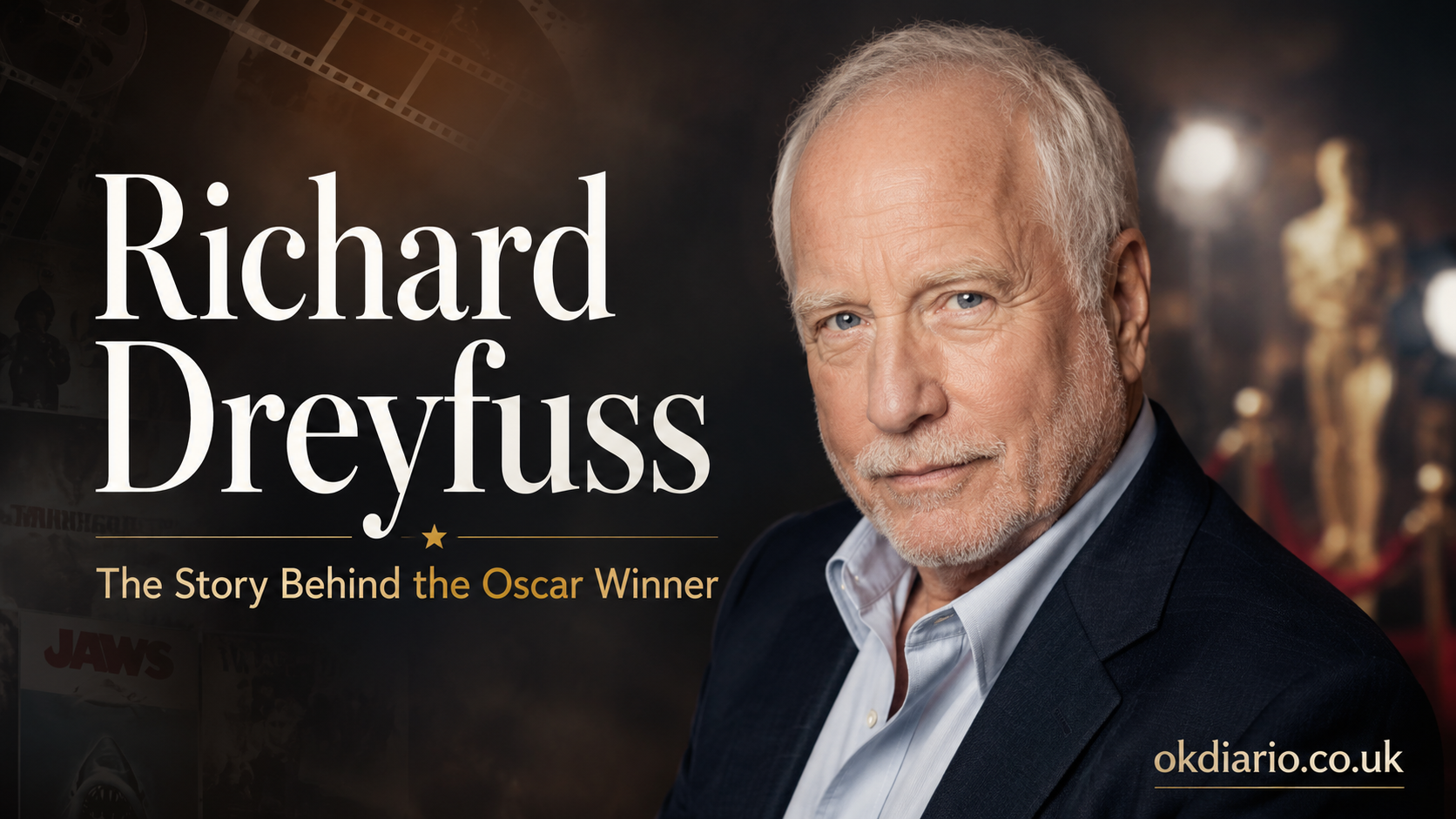
Richard Dreyfuss: The Story Behind the Oscar Winner
Some actors become closely associated with one unforgettable character. Others build careers by moving between comedy, drama, adventure, science fiction, and intimate character studies. Richard Dreyfuss belongs firmly in the second group.
For many viewers, he will always be Matt Hooper, the energetic marine biologist who joined the dangerous shark hunt in Jaws. Another generation remembers him as Roy Neary, the ordinary man drawn toward an extraordinary mystery in Close Encounters of the Third Kind. He also earned admiration as the difficult but charming Elliot Garfield in The Goodbye Girl and the dedicated music teacher at the centre of Mr. Holland’s Opus.
Those roles reveal the range behind his long career. His characters could be impatient, witty, insecure, ambitious, obsessive, warm, or deeply flawed. Instead of presenting traditional movie-star perfection, he often made nervous energy and emotional uncertainty central to his performances.
His Academy Award remains one of the defining achievements of his career, but the story behind the Oscar winner involves much more than a single ceremony. It includes early television work, a breakthrough during the New Hollywood era, major collaborations with Steven Spielberg, an acclaimed return to dramatic acting, and a lasting interest in civic education.
Richard Dreyfuss BIO Table
| Detail | Verified information |
|---|---|
| Professional name | Richard Dreyfuss |
| Full name | Richard Stephen Dreyfuss |
| Date of birth | October 29, 1947 |
| Birthplace | Brooklyn, New York City, United States |
| Age | 78, as of June 29, 2026 |
| Nationality | American |
| Profession | Actor, producer, author, and civic-education advocate |
| Career began | 1960s |
| Academy Award | Best Actor for The Goodbye Girl |
| Second Oscar nomination | Best Actor for Mr. Holland’s Opus |
| Golden Globe | Best Actor in a Motion Picture – Musical or Comedy for The Goodbye Girl |
| BAFTA | Best Actor for The Goodbye Girl |
| Hollywood Walk of Fame | Star awarded in 1996 |
| Children | Three |
| Current spouse | Svetlana Erokhin, publicly reported as married since 2006 |
| Net worth | Not publicly confirmed by an authoritative financial source |
Early Years in New York and California
Dreyfuss was born in Brooklyn on October 29, 1947. He spent part of his early childhood in New York before his family relocated to California while he was still young.
The move placed him closer to the entertainment industry, although success did not arrive instantly. He began developing his acting skills through youth theatre and gradually found opportunities on television. Like many performers of his generation, his early career was built through smaller appearances rather than an immediate starring role.
During the 1960s, he appeared in television productions and continued gaining experience on stage. These early assignments helped him develop the quick delivery, emotional intensity, and restless screen presence that later became recognisable parts of his acting style.
He did not fit the conventional image of a physically imposing Hollywood hero. That difference eventually became an advantage. He could convincingly portray intelligent but insecure young men, ordinary people facing extraordinary circumstances, and ambitious characters whose confidence often hid deeper uncertainty.
How Richard Dreyfuss Found His Place in New Hollywood
The American film industry changed significantly during the late 1960s and 1970s. Younger directors were experimenting with storytelling, while audiences became more open to leading characters who were complicated, nervous, rebellious, or morally imperfect.
That environment suited Dreyfuss.
His important early film work included George Lucas’s American Graffiti, released in 1973. The film followed a group of young people during one eventful night in California and later became recognised as an influential coming-of-age production.
As Curt Henderson, Dreyfuss played a thoughtful high-school graduate uncertain about leaving home. The performance was understated compared with some of his later work, but it demonstrated his ability to make indecision emotionally interesting. Curt was not a fearless hero. He was a young man caught between familiarity and the unknown.
The following year brought another major opportunity with The Apprenticeship of Duddy Kravitz. In the Canadian film, he played an intensely ambitious young man determined to gain status and success. The character’s energy, selfishness, humour, and vulnerability gave the actor a demanding role that strengthened his reputation.
Together, these films showed that he could carry a story without relying on a traditional leading-man image.
The Role of Matt Hooper in Jaws
The release of Jaws in 1975 transformed the careers of several people involved in the production and permanently changed the business of summer movies.
Directed by Steven Spielberg, the film follows police chief Martin Brody, marine biologist Matt Hooper, and professional shark hunter Quint as they attempt to stop a great white shark threatening the fictional community of Amity Island.
Dreyfuss played Hooper as intelligent, enthusiastic, and sometimes impatient. His scientific knowledge made him essential to the mission, but his privileged background and modern methods created tension with Quint, played by Robert Shaw.
Hooper could easily have been written as little more than the story’s technical expert. Instead, the performance gave him humour, ego, fear, and curiosity. His arguments with Quint provided some of the film’s most entertaining exchanges, while his growing friendship with Brody helped balance the darker elements of the story.
The success of Jaws made the actor internationally recognisable. More importantly, it demonstrated that his energetic personality could work inside a large-scale commercial production without being overwhelmed by the spectacle surrounding him.
Returning to Spielberg for Close Encounters
Dreyfuss reunited with Spielberg for Close Encounters of the Third Kind, released in 1977. This time, he played Roy Neary, an electrical worker whose encounter with an unidentified flying object gradually takes over his life.
Roy is not presented as a polished or consistently admirable hero. His obsession damages his family relationships and makes him appear increasingly unstable to the people around him. Yet the performance encourages viewers to understand his fascination, even when they cannot approve of his choices.
The famous image of Roy compulsively building a mountain-like shape from household materials captures the emotional centre of the character. He knows he has seen something important, but he cannot fully explain it.
The role required wonder, frustration, fear, and obsession, often within the same scene. It became one of the most distinctive performances of the actor’s career and helped make 1977 an exceptional professional year.
The Performance That Won the Oscar
The same year that audiences saw him in Close Encounters of the Third Kind, Richard Dreyfuss appeared in The Goodbye Girl, a romantic comedy written by Neil Simon and directed by Herbert Ross.
He played Elliot Garfield, an aspiring actor who unexpectedly has to share an apartment with dancer Paula McFadden, played by Marsha Mason, and her young daughter Lucy, played by Quinn Cummings.
Elliot is introduced as difficult, demanding, and highly confident in his artistic abilities. His arrival immediately creates conflict, especially because Paula has recently been abandoned and has little reason to trust another actor.
What makes the performance work is its balance. Elliot can be irritating without becoming impossible to like. His theatrical habits are funny, but the comedy does not completely hide his insecurity. As his relationship with Paula develops, his more considerate qualities emerge naturally.
At the 50th Academy Awards on April 3, 1978, Dreyfuss won the Oscar for Best Actor. He was 30 years and 156 days old, making him the youngest winner in that category at the time. The record remained his for approximately 25 years before Adrien Brody won for The Pianist at age 29.
The performance also earned him a Golden Globe and a BAFTA. These awards confirmed that his success was not limited to adventure films or science fiction. He could lead a dialogue-driven romantic comedy and create a character that felt both entertaining and emotionally believable.
Why The Goodbye Girl Remains Important
The Oscar victory is significant, but the film’s lasting appeal is rooted in its character relationships.
Elliot and Paula do not fall in love immediately. Their connection grows through arguments, practical compromises, disappointments, and moments of kindness. That gradual development gives the romance credibility.
The role also made strong use of Dreyfuss’s natural comic rhythm. He could deliver Neil Simon’s dialogue quickly without losing its emotional meaning. His physical reactions were equally important. A pause, a frustrated expression, or an awkward change in posture could reveal more than a longer speech.
The film offered proof that comedy and dramatic acting did not need to be treated as separate talents. His funniest moments often revealed Elliot’s vulnerability, while his most serious scenes still contained a sense of humour.
Career Choices After the Academy Award
Winning an Oscar can create unrealistic expectations. Every later performance is compared with the award-winning role, even when the new project has completely different goals.
Dreyfuss continued working in film, television, and theatre. His later career included commercial productions, smaller dramas, political films, comedies, and character roles.
Among his notable projects was Down and Out in Beverly Hills, a 1986 comedy in which he played a wealthy but dissatisfied businessman. That same year, he appeared in Stand by Me as the adult narrator whose memories frame the story.
In Stakeout, released in 1987, he played a police detective assigned to observe a woman connected to an escaped prisoner. The film combined comedy, romance, and crime, becoming a popular success and later receiving a sequel.
He worked with Spielberg again in Always, the 1989 romantic fantasy about a pilot who dies and attempts to guide the people he left behind.
Another widely remembered performance came in What About Bob? in 1991. He played Dr. Leo Marvin, a successful psychotherapist whose carefully controlled personal and professional life begins to collapse when an unusually dependent patient follows him on vacation.
The performance is an excellent example of controlled frustration becoming increasingly chaotic. While Bill Murray’s Bob remains outwardly pleasant, Leo grows more desperate and unreasonable. The contrast drives the comedy.
A Second Oscar Nomination for Mr. Holland’s Opus
In 1995, Dreyfuss delivered one of his most emotionally accessible performances in Mr. Holland’s Opus.
He played Glenn Holland, a composer who accepts a teaching position because he believes it will provide enough time and financial security to work on his own music. What begins as a practical job gradually becomes the central purpose of his life.
The film follows Holland across several decades, showing his development as a teacher, husband, father, and musician. His original ambitions do not disappear, but his understanding of achievement changes.
The performance avoids presenting Holland as a perfect educator. He can be distracted, impatient, and absorbed in his own disappointment. His growth comes from recognising the effect he has had on generations of students.
The role earned Dreyfuss his second Academy Award nomination for Best Actor at the 68th Academy Awards in 1996. Although Nicolas Cage won for Leaving Las Vegas, the nomination introduced the actor to viewers who may not have known his earlier work.
Selected Notable Films
| Film | Year | Role or importance |
|---|---|---|
| American Graffiti | 1973 | Played the uncertain graduate Curt Henderson |
| The Apprenticeship of Duddy Kravitz | 1974 | Delivered an important early leading performance |
| Jaws | 1975 | Played marine biologist Matt Hooper |
| Close Encounters of the Third Kind | 1977 | Starred as the increasingly obsessed Roy Neary |
| The Goodbye Girl | 1977 | Won the Academy Award for Best Actor |
| Down and Out in Beverly Hills | 1986 | Played businessman Dave Whiteman |
| Stand by Me | 1986 | Appeared as the adult narrator |
| Stakeout | 1987 | Led the comedy-thriller as Detective Chris Lecce |
| Always | 1989 | Reunited with director Steven Spielberg |
| What About Bob? | 1991 | Played psychotherapist Dr. Leo Marvin |
| The American President | 1995 | Appeared as Senator Bob Rumson |
| Mr. Holland’s Opus | 1995 | Received a second Best Actor Oscar nomination |
| W. | 2008 | Portrayed Vice President Dick Cheney |
| Madoff | 2016 | Played financier Bernard Madoff in the television miniseries |
| Book Club | 2018 | Appeared in the ensemble romantic comedy |
Television, Theatre, and Character Work
Although his best-known roles came from cinema, Dreyfuss also worked across television and theatre.
His television credits have included historical figures, fictional professionals, and complex public personalities. He portrayed organised-crime figure Meyer Lansky in the television film Lansky, appeared as Alexander Haig in The Day Reagan Was Shot, and later played Bernard Madoff in the miniseries Madoff.
He also starred in the television drama The Education of Max Bickford, playing a university professor dealing with changes in his professional and personal life.
Theatre remained part of his career as well. Stage acting requires different timing and discipline from film because a performance unfolds continuously in front of a live audience. His work across both formats reflects a career that was never limited to blockbuster filmmaking.
Acting Style and Screen Presence
One of the most recognisable qualities of his acting is the ability to make thought visible.
His characters often appear to be processing several emotions at once. They speak quickly, interrupt themselves, become distracted, or attempt to hide insecurity behind knowledge and confidence.
This approach is particularly effective when he plays specialists. Matt Hooper understands sharks. Roy Neary believes he has witnessed something extraordinary. Glenn Holland knows music. Dr. Leo Marvin believes he understands human behaviour.
However, professional expertise does not give these characters complete control over their lives. That contradiction makes them interesting. They may be intelligent, but they are rarely emotionally settled.
He is also effective at moving between humour and seriousness. A character may begin a scene as the most confident person in the room and end it embarrassed or overwhelmed. Those reversals create both comedy and empathy.
Public Family Information and Relationships
Richard Dreyfuss has been married three times according to established public biographies.
His first marriage was to writer and producer Jeramie Rain. They married in 1983, had three children, and divorced in 1995. He later married Janelle Lacey in 1999, with the marriage ending in 2005.
He married Svetlana Erokhin in 2006. Publicly available biographical sources continue to list her as his spouse.
No unverified romantic rumours are included here. Information about private family disagreements or claims from unnamed sources should not be presented as established fact. Only widely reported marital details are relevant to a responsible career biography.
Is His Net Worth Publicly Confirmed?
Several entertainment websites publish estimated celebrity wealth figures, but these estimates often differ and rarely provide access to audited financial records.
For that reason, no exact Richard Dreyfuss net worth figure should be treated as confirmed. His earnings would have been influenced by acting salaries, production agreements, property, taxes, professional expenses, investments, and other private financial matters.
Without authoritative documentation, the most accurate description is not publicly confirmed.
Work Beyond Acting
In addition to his entertainment career, Dreyfuss has spent years supporting greater emphasis on civic education.
He founded the Dreyfuss Civics Initiative, an organisation created to encourage the teaching of civics and the responsibilities of citizenship. The initiative became a recognised nonprofit organisation in 2008.
His interest in the subject has also appeared in public talks and writing. In 2022, he published One Thought Scares Me…, a book focused on the role education plays in preserving civic knowledge.
Whether readers agree with all of his public opinions or not, civic education has clearly become an important part of his public work outside acting.
Awards and Career Recognition
His major honours include:
- Academy Award for Best Actor for The Goodbye Girl
- Golden Globe for The Goodbye Girl
- BAFTA award for The Goodbye Girl
- Academy Award nomination for Mr. Holland’s Opus
- Golden Globe nominations for American Graffiti and Mr. Holland’s Opus
- BAFTA nomination for Jaws
- A star on the Hollywood Walk of Fame, awarded in 1996
These honours reflect different stages of his career. The awards for The Goodbye Girl recognised a young performer at the height of his 1970s success, while the nomination for Mr. Holland’s Opus demonstrated his ability to deliver acclaimed work nearly two decades later.
Frequently Asked Questions
How old is Richard Dreyfuss?
He was born on October 29, 1947. He is 78 years old as of June 29, 2026, and will turn 79 on October 29, 2026.
What did Richard Dreyfuss win an Oscar for?
He won the Academy Award for Best Actor for playing Elliot Garfield in the 1977 romantic comedy The Goodbye Girl. The award was presented at the 50th Academy Awards on April 3, 1978.
Was he in Jaws?
Yes. He played marine biologist Matt Hooper in Steven Spielberg’s Jaws, released in 1975. The role became one of his most recognisable performances.
Did he receive another Academy Award nomination?
Yes. He received a second Best Actor nomination for his performance as Glenn Holland in the 1995 drama Mr. Holland’s Opus.
What are his most notable movies?
His best-known films include American Graffiti, The Apprenticeship of Duddy Kravitz, Jaws, Close Encounters of the Third Kind, The Goodbye Girl, Stand by Me, Stakeout, Always, What About Bob?, The American President, and Mr. Holland’s Opus.
Who is his wife?
Public biographical records list Svetlana Erokhin as his wife. They married in 2006. He was previously married to Jeramie Rain and Janelle Lacey.
What is his confirmed net worth?
His exact net worth is not publicly confirmed. Figures published by celebrity-finance websites should be treated only as unofficial estimates, not verified financial facts.
Conclusion
Richard Dreyfuss built his reputation during one of the most important periods in modern American filmmaking. Within a few remarkable years, he appeared in American Graffiti, The Apprenticeship of Duddy Kravitz, Jaws, Close Encounters of the Third Kind, and The Goodbye Girl.
Winning the Academy Award at 30 gave him a permanent place in Oscar history, but his career cannot be reduced to that single achievement. His later work in What About Bob?, The American President, and Mr. Holland’s Opus showed that he could remain compelling across different genres and stages of life.
The strongest performances in his filmography are often built around imperfect people. His characters are intelligent but uncertain, confident but emotionally vulnerable, funny but capable of causing pain. That complexity helped them feel recognisably human.
Decades after his breakthrough, audiences continue to discover his work through suspense films, science-fiction classics, comedies, dramas, and television productions. The Oscar is an important part of his story, but the variety and longevity of the career behind it provide the fuller picture.