

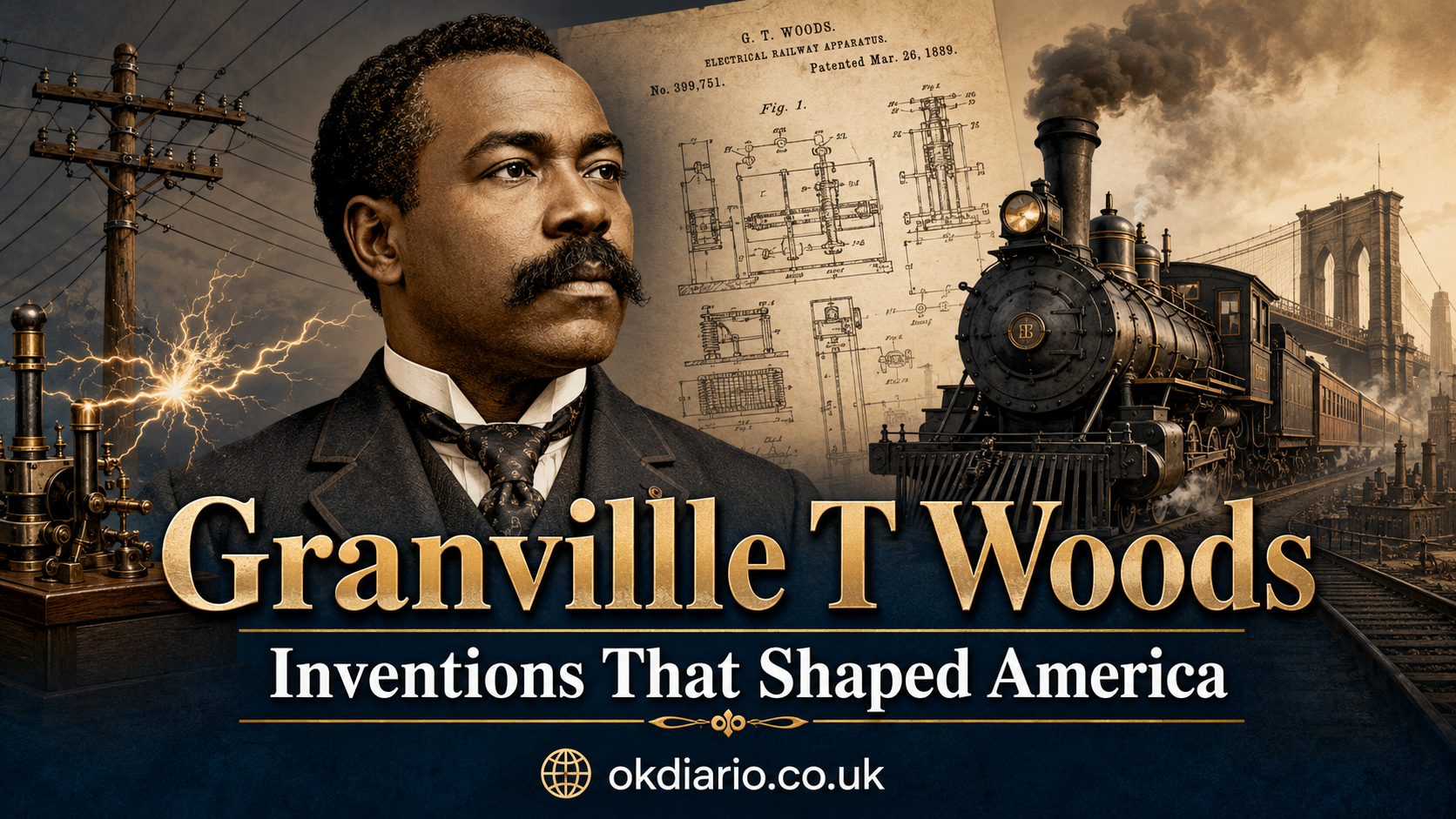
The Inventor America Should Talk About More
Some names appear again and again in history books. Thomas Edison. Alexander Graham Bell. Nikola Tesla. Their stories are printed, repeated, and celebrated. But when we talk about the inventors who helped shape modern America, one brilliant mind still does not get the attention he deserves: Granville T Woods.
Granville T Woods was not just an inventor. He was a thinker, a problem-solver, an electrical pioneer, and one of the most important African American inventors of the 19th century. His work improved railway safety, communication systems, electrical transportation, and telegraph technology. In many ways, he helped America move faster, communicate better, and travel more safely.
What makes his story even more powerful is the world he lived in. Granville T Woods built his career during a time when Black inventors faced racism, limited education access, and serious barriers in business. Still, he earned dozens of patents and created inventions that served real public needs.
His life was not easy. His success was not handed to him. Yet his ideas left a mark on American industry, especially the railway system. That is why the story of Granville T Woods is more than a biography. It is a story of courage, intelligence, and innovation under pressure.
Granville T Woods Bio
| Detail | Information |
|---|---|
| Full Name | Granville Tailer Woods |
| Date of Birth | April 23, 1856 |
| Age | 53 at the time of his death |
| Profession | Inventor, Electrical Engineer, Mechanical Engineer |
| Nationality | American |
| Net Worth (approx.) | Not publicly documented |
| Notable Works / Achievements | Synchronous Multiplex Railway Telegraph, Railway Telegraphy, Electric Railway Systems, Telegraphony, Over 50 patents |
Who Was Granville T Woods?
Granville T Woods was an American inventor best known for his major contributions to railway communication and electrical engineering. He was born in Columbus, Ohio, in 1856. From a young age, he showed a deep interest in machines, electricity, and how things worked.
He did not come from wealth. He also did not enjoy the kind of educational opportunities many famous inventors had. Still, he taught himself much of what he knew through reading, observation, work experience, and constant practice. That is one reason his story feels so inspiring. He did not wait for perfect conditions. He used what he had and kept learning.
Over time, Granville T Woods became known for inventions that improved the safety and performance of trains. During the late 1800s, railways were the backbone of American growth. Trains moved people, goods, mail, coal, steel, and ideas across the country. However, railway travel was dangerous. Communication between moving trains and stations was limited, and accidents were common.
Woods saw this problem clearly. Then he worked on solutions.
His inventions helped trains communicate better while moving. That was a big deal. It meant fewer collisions, better scheduling, and safer travel. Because of this work, many people called him the “Black Edison.” Although the nickname shows respect, it also tells us something important: Granville T Woods was a genius in his own right, not just a comparison to someone else.
Early Life and Education of Granville T Woods
Granville T Woods was born at a time when America was deeply divided by race, class, and opportunity. As a Black child in the mid-1800s, his path was never going to be simple. Formal education was limited, and many doors were closed before he even reached them.
Still, Woods had something that could not be easily taken away: curiosity.
He attended school for only part of his childhood, but he continued learning on his own. He was especially interested in mechanical and electrical subjects. While many people saw machines as tools, Woods saw them as puzzles. He wanted to understand how every part worked and how each design could be improved.
As a young man, he worked in different technical jobs. These jobs gave him hands-on experience with railroads, machinery, and electrical systems. He worked as a fireman, engineer, and mechanic. Each role taught him something valuable.
This practical experience became one of his biggest strengths. Granville T Woods did not invent from theory alone. He understood real problems because he had seen them up close. He knew how rail systems operated. He understood the risks. He knew what workers needed. That real-world knowledge shaped his inventions.
Why Granville T Woods Matters in American History
Granville T Woods matters because his inventions supported the rise of modern transportation and communication. His work came during a period when America was changing quickly. Cities were growing. Factories were expanding. Railroads were connecting states and industries like never before.
In that fast-moving world, communication was everything.
If railway workers could not communicate clearly, trains could crash. If signals failed, schedules could fall apart. If electrical systems were weak, transportation would remain limited. Granville T Woods focused on these problems and created practical solutions.
His story also matters because it challenges the narrow way history is often told. Many Black inventors helped build modern America, yet their names are not always remembered. Woods is a perfect example. His ideas served the public, helped industries, and influenced future technology. However, his name is still not as widely known as it should be.
Learning about Granville T Woods gives readers a fuller, fairer view of American innovation. It reminds us that genius has never belonged to one race, one class, or one background.
The Major Inventions of Granville T Woods
Granville T Woods created many inventions during his career. Some were linked to railways. Others focused on electricity, telegraphy, and communication. His inventions were practical, useful, and often ahead of their time.
Synchronous Multiplex Railway Telegraph
One of the most famous inventions by Granville T Woods was the Synchronous Multiplex Railway Telegraph. This device allowed train stations and moving trains to communicate with each other.
At the time, this was a huge breakthrough. Trains often traveled long distances with limited communication. If two trains were on the same track, workers sometimes had no quick way to warn them. This could lead to deadly accidents.
Woods’ system helped solve this by allowing messages to be sent between moving trains and railway stations. It improved safety and made railway operations more efficient.
This invention showed the heart of Woods’ genius. He did not invent just to impress people. He invented to solve dangerous problems.
Railway Telegraphy Improvements
Granville T Woods also improved railway telegraph systems. Telegraphy was one of the most important communication technologies of the 19th century. It allowed messages to travel over wires much faster than letters or messengers.
However, railway telegraphy had limits. Woods worked on ways to make these systems stronger, faster, and more useful for railway companies. His ideas helped improve how trains were managed and monitored.
These improvements were not small. In an age before mobile phones, radios, and digital tracking, better telegraph systems could save lives.
Telegraphony
Another important area of work for Granville T Woods was telegraphony. This invention combined features of the telegraph and telephone. It was designed to send voice and telegraph messages over the same wire.
That idea may sound simple today, but at the time it was highly advanced. Communication technology was still developing, and inventors were searching for better ways to send information over long distances.
Woods understood that the future would depend on faster and more flexible communication. His work in this area showed his ability to think beyond the technology of his own time.
Electric Railway Systems
Granville T Woods also contributed to electric railway technology. During the late 1800s, cities were looking for better public transportation. Horse-drawn streetcars were slow, messy, and limited. Electric railways offered a cleaner and more powerful option.
Woods worked on electrical systems that supported railway operation. His inventions helped improve how electric trains and streetcars could function.
This work placed him in the middle of one of the biggest transportation shifts in American cities. As urban areas grew, electric transit became more important. Woods’ contributions helped support that progress.
Other Patents and Technical Work
Granville T Woods held many patents across different fields. His ideas covered railway brakes, electrical circuits, communication tools, and power systems. He was not limited to one invention or one industry.
Some key areas connected to his work include:
- Railway safety systems
- Electrical engineering
- Train communication
- Telegraph technology
- Telephone improvements
- Electric rail transport
- Mechanical devices
- Power distribution
- Industrial innovation
- Urban transportation
This wide range shows how creative and flexible he was. He was not just an inventor with one lucky idea. He was a serious technical mind who kept producing useful solutions.
Granville T Woods and the Railway Revolution
To understand the importance of Granville T Woods, we need to understand how important railways were in his time.
In the 19th century, railroads were like the internet of transportation. They connected cities, businesses, farms, ports, and factories. A strong railway system helped the economy grow. It also changed how people lived and worked.
However, the railway system had serious safety issues. Trains moved fast, but communication moved slowly. Workers had to depend on signals, schedules, and station messages. When something went wrong, there was not always a quick way to respond.
Granville T Woods improved this system by making communication more direct and reliable. His inventions helped trains exchange information while in motion. This made railway travel safer and more organized.
In a simple way, Woods gave trains a better voice.
That is why his work mattered so much. He did not just add another device to the world. He helped improve one of America’s most important industries.
The “Black Edison” Nickname
Granville T Woods was often called the “Black Edison.” On one hand, the nickname reflected his brilliance. It showed that people recognized his talent and compared him with one of the most famous inventors in history.
However, the nickname can also feel limiting.
Granville T Woods deserves to be remembered by his own name. He was not simply a Black version of another inventor. He had his own ideas, his own struggles, and his own achievements. His inventions were rooted in his personal experience, his technical skill, and his deep understanding of railway systems.
Still, the nickname helped some people notice him during his lifetime. It gave the public a quick way to understand the level of his talent. But today, we can go further. We can say clearly that Granville T Woods was one of America’s great inventors, without needing to place him in another man’s shadow.
Challenges Granville T Woods Faced
The success of Granville T Woods becomes even more impressive when we look at the challenges he faced.
He lived during a period when racism affected almost every part of American life. Black professionals were often denied fair treatment, funding, business respect, and legal support. Even when they created valuable inventions, they had to fight harder for recognition.
Woods also faced financial struggles. Like many inventors, he needed money to develop, patent, and protect his ideas. Patents cost money. Legal battles cost money. Business promotion cost money. For a Black inventor in the 1800s, raising support was especially difficult.
In addition, some of his inventions were challenged by powerful people and companies. Patent disputes were common in that era, and Woods had to defend his rights. These challenges could have stopped him. Instead, he kept working.
That persistence is one of the strongest parts of his story. Granville T Woods did not have an easy road, but he kept moving forward.
Patent Battles and Recognition
Invention is not only about having a good idea. It is also about protecting that idea.
Granville T Woods understood this well. He filed patents to secure legal rights over his inventions. These patents proved that his ideas were original and valuable.
However, patent protection was not always simple. During his career, Woods faced disputes over some of his inventions. In one famous case, Thomas Edison reportedly challenged one of Woods’ patents related to railway telegraphy. Woods successfully defended his work.
That moment is important because it shows how serious and credible his inventions were. He was not working on small, forgotten ideas. His inventions were valuable enough to attract attention from major figures in the industry.
Woods later sold some of his patents to large companies. This was common among inventors who needed funds or business partners to bring ideas into wider use. Still, it also meant that others sometimes gained more public attention from technologies he helped create.
How Granville T Woods Helped Shape America
The title “Granville T Woods: Inventions That Shaped America” fits because his work touched systems that helped build the modern nation.
America’s growth depended on movement and communication. People needed to travel. Businesses needed goods shipped. Cities needed public transit. Railway companies needed safer systems. Communication networks needed better design.
Granville T Woods contributed to all of these areas.
His inventions helped America in several important ways:
- They improved railway safety
- They made train communication more reliable
- They supported electric transportation
- They advanced telegraph and telephone technology
- They helped modernize urban transit
- They inspired future Black inventors and engineers
- They proved that innovation can come from overlooked communities
In addition, his work helped create public trust in new transportation systems. When technology becomes safer, people use it more. When communication becomes faster, industries grow stronger. Woods understood this connection.
Granville T Woods as an Electrical Pioneer
Electricity was one of the most exciting fields of the 19th century. It promised light, speed, power, and connection. Inventors across America were racing to discover what electricity could do.
Granville T Woods was part of that movement.
He understood electrical systems at a high level, even though he did not follow the traditional path of elite education. He studied, tested, improved, and invented. His work with electric railways and communication systems placed him among the important electrical pioneers of his era.
What made him special was his practical focus. He often applied electrical ideas to real transportation problems. He was not interested in theory alone. He wanted systems that worked in daily life.
This practical genius is one reason his inventions had lasting value.
The Human Side of Granville T Woods
It is easy to talk about patents and machines, but Granville T Woods was also a human being with ambition, pressure, and disappointment.
Imagine working hard on an invention while knowing that many people may judge you before they even see your work. Imagine creating something useful, then having to fight for credit. Imagine being brilliant in a country that often refused to treat Black talent fairly.
That was the world Woods had to navigate.
Yet he kept creating.
There is something deeply moving about that. His story is not only about machines. It is about belief. He believed his ideas mattered. He believed problems could be solved. He believed his work deserved a place in the future.
And he was right.
Granville T Woods and Black Innovation
Granville T Woods belongs to a proud tradition of Black inventors who changed American life. These inventors often worked without the fame, funding, or protection given to others. Still, their ideas improved homes, farms, factories, roads, railways, and cities.
Woods’ success showed that Black inventors were not just participating in American progress. They were leading parts of it.
His story is especially important for students, young engineers, and anyone interested in science and technology. It proves that talent can rise from difficult circumstances. It also reminds us why representation in history matters.
When people learn about Granville T Woods, they see a fuller picture of invention. They see that American innovation was built by many hands and many minds.
Lessons We Can Learn from Granville T Woods
The life of Granville T Woods offers many lessons that still feel useful today.
Curiosity Can Change a Life
Woods was curious from a young age. He wanted to know how things worked. That curiosity pushed him to learn, experiment, and improve.
Practical Experience Matters
He gained knowledge through real work. His jobs gave him insight into railway systems and mechanical problems. That experience helped him invent better solutions.
Persistence Is Powerful
Granville T Woods faced racism, money problems, and legal challenges. However, he did not stop. His persistence became part of his success.
Innovation Should Solve Real Problems
Many of Woods’ inventions were designed to make travel safer and communication better. He focused on usefulness, not just fame.
Recognition Can Come Late, But Impact Lasts
Woods did not always receive the recognition he deserved during his lifetime. Even so, his impact continued through the systems and ideas he helped improve.
Why Granville T Woods Is Still Relevant Today
Today, we live in a world powered by communication, transportation, and electrical systems. Trains, subways, phones, signals, and networks are part of daily life. While technology has changed, the basic need remains the same: people need safe movement and reliable communication.
That is exactly where Granville T Woods made his mark.
His work reminds us that technology should serve people. It should make life safer, easier, and more connected. His inventions also remind us that progress often begins with someone noticing a problem others ignore.
In the modern world, where young people are encouraged to enter science, technology, engineering, and math fields, Woods’ life is a strong example. He shows that invention is not only for those with perfect backgrounds. It is for people who observe, learn, test, fail, and try again.
Common Facts About Granville T Woods
Here are some quick facts that readers often want to know:
| Fact | Detail |
|---|---|
| Birthplace | Columbus, Ohio |
| Main Field | Electrical and mechanical inventions |
| Most Famous Area | Railway communication systems |
| Common Nickname | The Black Edison |
| Number of Patents | More than 50 patents |
| Key Invention | Synchronous Multiplex Railway Telegraph |
| Historical Importance | Improved railway safety and communication |
| Legacy | One of the most important African American inventors |
Granville T Woods in Simple Words
If we explain Granville T Woods in simple words, we can say this: he was an inventor who helped trains communicate better and travel more safely.
That may sound basic, but it was revolutionary in his time.
Before advanced radio and digital systems, moving trains needed better ways to send and receive information. Woods helped make that possible. His work reduced risk and improved efficiency. He used electrical knowledge to solve real transportation problems.
That is why Granville T Woods deserves a strong place in American history.
Why His Story Should Be Taught More
Many students learn about famous inventors, but they may never hear much about Granville T Woods. That should change.
His story teaches history, science, engineering, and social justice at the same time. It shows how invention works. It shows how society can overlook great talent. It also shows why we need to tell more complete stories about the people who built modern life.
Teaching about Woods can inspire students who do not always see themselves in science books. It can also help all readers understand that innovation comes from many communities.
In addition, his story adds depth to the history of American railroads. Railways were not improved by one person or one company. They were shaped by many inventors, workers, engineers, and thinkers. Granville T Woods was one of the most important among them.
The Legacy of Granville T Woods
The legacy of Granville T Woods lives in more than his patents. It lives in the idea that intelligence can overcome barriers. It lives in safer transportation systems. It lives in the history of electrical communication. It lives in every student who discovers his name and thinks, “I did not know that.”
His work helped America move forward during a critical period of growth. His inventions supported railway safety, electrical engineering, and communication technology. His courage also opened doors for later inventors.
Granville T Woods died in 1910, but his story did not end there. Every time we talk about forgotten inventors, Black excellence, railway history, or American innovation, his name belongs in the conversation.
He was not just an inventor of machines. He was an inventor of possibility.
Conclusion: Granville T Woods Deserves a Bigger Place in History
Granville T Woods was one of the great inventors of American history. His inventions improved railway communication, supported electric transportation, and helped shape safer travel. He worked in a difficult time, faced serious barriers, and still earned a place among the most important technical minds of the 19th century.
The story of Granville T Woods is powerful because it combines genius with grit. He did not have an easy path, but he created ideas that mattered. His inventions helped America grow, move, and communicate.
Today, his name should be remembered with pride. Whether you are a student, history lover, engineer, writer, or someone who enjoys stories of real achievement, Granville T Woods is worth knowing.
If this story inspired you, share it with someone who loves history, invention, or untold stories of American greatness. The more we talk about Granville T Woods, the more we give his legacy the respect it has always deserved.