

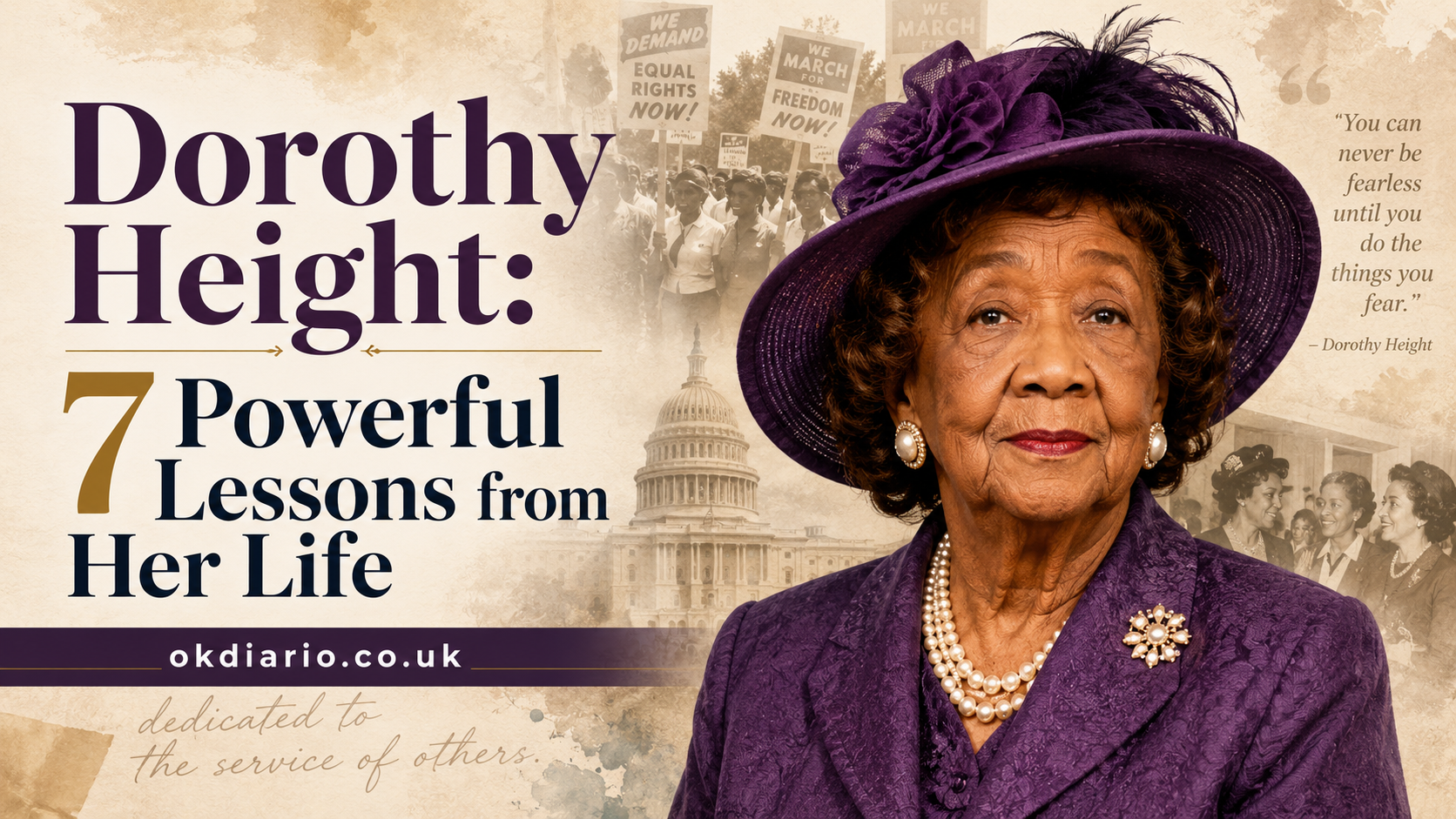
Dorothy Height: 7 Powerful Lessons from Her Life
Some people make noise to be noticed. Others change history so deeply that the world keeps feeling their work long after they are gone. Dorothy Height belonged to the second group.
She was not always the loudest voice in the room. She was not always given the microphone. In fact, even when she helped organize one of the most famous civil rights events in American history, she was not invited to speak. Yet her influence was everywhere. Behind the speeches, behind the marches, behind the policy meetings, behind the steady push for justice, there was Dorothy Height, working with patience, intelligence, and quiet power.
Her story is not just a biography. It is a lesson in leadership. It is a reminder that real change often comes from people who stay committed when attention moves elsewhere. Dorothy Height fought for civil rights, women’s rights, racial justice, voter registration, education, economic opportunity, and dignity for African American women. She spent her life building bridges where others built walls.
Today, her name deserves more than a passing mention in history books. Dorothy Height’s life gives us practical lessons about courage, discipline, service, and purpose. Whether you are a student, leader, activist, writer, entrepreneur, teacher, or simply someone trying to live with meaning, her journey still speaks clearly.
Dorothy Height Bio
| Detail | Information |
|---|---|
| Full Name | Dorothy Irene Height |
| Date of Birth | March 24, 1912 |
| Age | 98 at the time of her death |
| Profession | Civil rights activist, women’s rights leader, educator, social worker |
| Nationality | American |
| Net Worth Approx. | Not publicly confirmed; her legacy was mainly civic, not financial |
| Notable Works / Achievements | President of the National Council of Negro Women, civil rights organizer, women’s rights advocate, Presidential Medal of Freedom recipient, Congressional Gold Medal recipient |
Dorothy Height was born in Richmond, Virginia, and became one of the most respected leaders in the American civil rights movement. She later served as president of the National Council of Negro Women for decades and helped shape important efforts around voter registration, racial justice, and women’s leadership.
Who Was Dorothy Height?
Dorothy Height was an American civil rights and women’s rights activist who focused strongly on the needs of African American women. That detail matters because she understood something many leaders ignored at the time: racism and sexism did not exist in separate boxes. For Black women, these struggles often happened at the same time.
She worked with major civil rights figures, advised political leaders, and helped organize movements that changed American society. Still, her work was often less visible than the work of male leaders. That does not make her role smaller. If anything, it makes her story even more powerful.
Dorothy Height joined the National Council of Negro Women as a young activist and later became its president in 1957. Under her leadership, the organization grew in influence and supported voter education, community development, family programs, equal opportunity, and civil rights action.
She was also connected to the YWCA and worked to challenge segregation and racial injustice. Her work was not limited to speeches. She organized programs, mentored women, pushed institutions to change, and helped create real opportunities for communities that had been ignored.
Lesson 1: Lead Even When You Are Not Given the Spotlight
One of the most powerful lessons from Dorothy Height’s life is this: leadership is not always about being seen. Sometimes leadership means doing the work even when others get the credit.
Dorothy Height helped organize the 1963 March on Washington for Jobs and Freedom. It became one of the defining moments of the civil rights movement. Martin Luther King Jr. gave his famous “I Have a Dream” speech there. The world remembers the march as a turning point in American history.
Yet Dorothy Height, despite her major role, was not invited to speak on the main program. Women were largely pushed to the side during that historic event. That fact is painful, but it also reveals something important about her character. She did not stop working because she was overlooked.
Many people would have walked away. Many would have become bitter. Dorothy Height stayed focused on the mission.
What This Teaches Us Today
In modern life, people often chase visibility. Social media numbers, public praise, awards, and recognition can make us feel successful. However, Dorothy Height reminds us that impact is bigger than applause.
Real leadership means:
- Showing up when the work is hard
- Staying steady when recognition is missing
- Serving the mission, not just the ego
- Helping others rise, even when your own name is not centered
This is why Dorothy Height remains such a strong example. She knew that justice was more important than personal attention.
Lesson 2: Connect Struggles Instead of Separating Them
Dorothy Height understood intersectionality before the word became common in public conversations. She saw that African American women faced both racial discrimination and gender inequality. She did not treat these issues as separate problems. Instead, she built her work around the truth that people’s lives are complex.
For example, a Black woman seeking a job might face racism from employers and sexism from society. A young girl trying to get an education might face barriers because of her race, gender, class, or all three. Dorothy Height paid attention to these layers.
That made her leadership wise and practical.
Why This Matters
Some movements fail because they ignore parts of people’s experiences. Dorothy Height did the opposite. She listened. She studied the real problems facing families. She cared about jobs, schools, voting rights, health, housing, safety, and respect.
Her work with the National Council of Negro Women focused on improving life for African American women and their families. It was not only about protest. It was also about building stronger communities.
In addition, she helped bring women into conversations about civil rights and helped bring racial justice into conversations about women’s rights. That bridge-building made her one of the most important leaders of the 20th century.
Lesson 3: Education Can Become a Tool for Freedom
Dorothy Height valued education deeply. She was known as a bright student and strong speaker from a young age. She later studied at New York University, earning degrees in education and psychology after being denied entry to Barnard College because of racial limits at the time.
That moment could have crushed her. Imagine working hard, earning your place, and then being told no because of your race. But Dorothy Height did not allow rejection to define her future. She found another path and kept moving.
Her education did not stay on paper. She used it in real life. She understood people. She understood systems. She understood how young women needed support, training, confidence, and opportunity.
The Deeper Lesson
Education is not only about degrees. It is about learning how the world works and then using that knowledge to make it better.
Dorothy Height used education to:
- Speak with clarity
- Organize communities
- Understand social problems
- Train future leaders
- Challenge unfair systems
- Build strong institutions
For readers today, this lesson is simple but powerful. Do not learn only to impress people. Learn so you can serve better, think better, and lead better.
Lesson 4: Courage Can Be Quiet and Still Change Everything
When people imagine courage, they often picture dramatic moments. A loud speech. A public confrontation. A single brave act. Dorothy Height’s courage was different. It was steady. It was disciplined. It lasted for decades.
She fought for civil rights during a time when racism was not hidden. Segregation, discrimination, voter suppression, unequal schools, and unfair treatment were daily realities for millions of African Americans. Speaking out was not easy. Organizing was not safe. Challenging power always carried risk.
Still, Dorothy Height kept working.
She met with leaders. She advised presidents. She supported activists. She helped women organize. She stood for equality in rooms where women, especially Black women, were often ignored.
Quiet Courage Is Still Courage
Not everyone is called to lead from a stage. Some people lead through planning, mentoring, writing, teaching, organizing, or caring for their community. Dorothy Height showed that courage does not need to be loud to be real.
Her courage looked like patience. It looked like strategy. It looked like staying in the fight for more than one season.
That kind of courage is rare. It is also the kind that changes history.
Lesson 5: Build Institutions, Not Just Moments
A march can inspire people. A speech can move hearts. A headline can start a conversation. However, institutions carry work forward.
Dorothy Height understood this better than most. Her long leadership with the National Council of Negro Women helped create lasting programs, networks, and influence. She did not only react to problems. She helped build structures that could support people over time.
That is one reason her legacy feels so strong. She was not just part of history. She helped organize history.
Why Institutions Matter
Movements need passion, but they also need planning. They need people who can manage details, raise funds, train volunteers, create partnerships, and keep the doors open.
Dorothy Height helped turn values into action. Through her leadership, civil rights and women’s rights became more than ideas. They became programs, meetings, campaigns, and community support systems.
This is a lesson for anyone who wants to make a difference. Passion is a start, but structure gives passion a place to grow.
Lesson 6: Work With Others Without Losing Your Voice
Dorothy Height worked with some of the most famous leaders in American history. She was connected to figures such as Mary McLeod Bethune, Martin Luther King Jr., A. Philip Randolph, Whitney Young, Eleanor Roosevelt, and political leaders in Washington. Her advice was respected by people in power, including U.S. presidents.
However, she did not become a shadow of those around her. She kept her own purpose. She stayed focused on African American women, families, civil rights, and equal opportunity.
That balance is not easy.
Some people lose themselves when they enter powerful circles. Others refuse to work with anyone who does not agree with them completely. Dorothy Height found a wiser path. She collaborated, but she did not disappear.
A Practical Leadership Lesson
Working with others does not mean giving up your values. It means finding ways to move the mission forward.
Dorothy Height showed how to:
- Build coalitions
- Stay respectful under pressure
- Speak with wisdom
- Protect the needs of overlooked communities
- Work across movements
- Keep long-term goals in view
In today’s world, this lesson matters more than ever. Progress often requires teamwork. But teamwork works best when people bring both humility and backbone.
Lesson 7: Legacy Is Built Through Service
Dorothy Height received major honors later in life, including the Presidential Medal of Freedom and the Congressional Gold Medal. These awards recognized what many communities already knew: her life had changed the country.
But her greatest legacy was not a medal. It was the people she helped. It was the young women she inspired. It was the voters she encouraged. It was the families strengthened by her programs. It was the civil rights movement made stronger because she refused to quit.
Dorothy Height lived with service at the center.
What Her Legacy Means Now
Legacy is not only what people say about you after you are gone. It is what continues because you were here.
Because of Dorothy Height, more people understand that racial justice and women’s equality are connected. More people know that Black women were not side characters in the civil rights movement. More people see leadership as service, not performance.
That is a legacy worth studying.
Dorothy Height’s Major Achievements
Here is a simple look at some of the achievements connected to Dorothy Height’s life and work:
| Area | Contribution |
|---|---|
| Civil Rights | Helped organize and advise major civil rights efforts |
| Women’s Rights | Advocated for African American women and gender equality |
| Leadership | Served as president of the National Council of Negro Women |
| Education | Used her academic background to support social reform |
| Community Work | Helped create programs focused on families, opportunity, and justice |
| National Recognition | Received major U.S. honors for public service |
| Historical Legacy | Known as a key figure in linking civil rights and women’s rights |
Why Dorothy Height Still Matters Today
Dorothy Height still matters because the issues she fought against have not fully disappeared. Inequality, discrimination, voter access, workplace bias, education gaps, and gender barriers still affect many communities. Her work gives modern readers a model for how to respond.
She did not wait for perfect conditions. She did not wait for everyone to agree. She did not need constant praise. She simply kept working.
That is why Dorothy Height feels so relevant now.
In a time when many people want fast results, her life teaches patience. In a time when many people want attention, she teaches service. In a time when public debate can feel shallow, she teaches depth. In a time when movements can become divided, she teaches connection.
LSI Keywords Naturally Related to Dorothy Height
To understand the full meaning of Dorothy Height’s story, it helps to see the wider world around her life and work. Her legacy connects with many important ideas, including:
Civil rights movement, women’s rights, African American history, social justice, racial equality, gender equality, Black leadership, voter registration, community organizing, equal opportunity, National Council of Negro Women, YWCA, March on Washington, public service, human rights, education reform, activism, leadership, social work, American history, Black women leaders, political advocacy, economic justice, racial discrimination, segregation, equality movement, women empowerment, civic engagement, justice, freedom, dignity, public policy, grassroots organizing, civil rights leaders, feminist history, African American women, leadership lessons, historical legacy, social change, community development, moral courage, national honors, Presidential Medal of Freedom, Congressional Gold Medal, Black history, American activists, women in history, equality for all, voting rights, humanitarian work, mentorship, service leadership, social reform, empowerment, public speaking, institutional change, bridge-building, moral leadership, and lasting impact.
These terms are not just SEO phrases. They are part of the world Dorothy Height helped shape.
Dorothy Height and the Power of Being Underestimated
One of the most moving parts of Dorothy Height’s life is how often she was underestimated. She lived in a time when Black women were expected to carry heavy burdens but receive little credit. They were asked to serve, but not always allowed to lead publicly.
Dorothy Height challenged that unfair pattern.
She did not always challenge it by demanding attention. Often, she challenged it by being excellent. She prepared. She organized. She spoke with intelligence. She kept showing up in important rooms. She became someone leaders trusted because she had earned that trust over years of consistent work.
That is a powerful message for anyone who feels overlooked.
Being underestimated does not mean you are powerless. Sometimes it means people have not yet understood your strength. Dorothy Height proved that quiet excellence can become impossible to ignore.
How Dorothy Height Inspired Future Generations
Dorothy Height inspired future generations by showing that leadership is not limited to one style. You do not have to be loud to be strong. You do not have to be famous to be effective. You do not have to be perfect to be useful.
Her life continues to inspire:
- Young women who want to lead
- Students learning Black history
- Activists fighting for fairness
- Community workers serving families
- Teachers explaining civil rights
- Writers telling overlooked stories
- Leaders trying to build lasting change
Moreover, Dorothy Height gives people permission to lead from where they are. She shows that your voice matters even if the world has been slow to hear it.
Common Questions About Dorothy Height
What is Dorothy Height best known for?
Dorothy Height is best known for her work as a civil rights and women’s rights leader. She served as president of the National Council of Negro Women and worked for racial justice, gender equality, voter education, and community development.
Was Dorothy Height part of the civil rights movement?
Yes. Dorothy Height was one of the most influential women in the civil rights movement. She worked with major leaders, helped organize important efforts, and advised on political and social issues connected to equality.
Why is Dorothy Height important?
Dorothy Height is important because she connected the fight for civil rights with the fight for women’s rights. She focused on African American women and helped make their experiences part of the national conversation.
What awards did Dorothy Height receive?
Dorothy Height received several major honors, including the Presidential Medal of Freedom and the Congressional Gold Medal, recognizing her lifelong public service and leadership.
Final Thoughts: Dorothy Height’s Life Still Speaks
Dorothy Height lived a life of purpose. Not a perfect life. Not an easy life. But a meaningful one.
She faced racism, sexism, rejection, and public silence. Yet she kept moving forward. She helped organize, educate, mentor, advise, and lead. She stood at the crossroads of civil rights and women’s rights and refused to choose only one. She understood that justice must include everyone, or it is not justice at all.
The seven lessons from Dorothy Height’s life are clear. Lead even without the spotlight. Connect struggles instead of separating them. Use education as a tool for freedom. Practice quiet courage. Build institutions, not just moments. Work with others without losing your voice. And above all, build a legacy through service.
That is why Dorothy Height is more than a historical figure. She is a guide.
Her story asks each of us a simple question: what are we doing with the influence we have?
If Dorothy Height’s life inspired you, share this article with someone who values courage, history, and leadership. And if one lesson stood out most, leave a comment and keep the conversation going.